
A familiar upright arrangement fits 15 products in this shipping box. When all three verified orientations are considered together, the same box fits 18—a 20% capacity increase without changing either the product or the box dimensions.
That is the practical question behind a box packing calculator: not just whether a product fits, but whether a habitual way of placing it is leaving usable space behind.
A realistic export-box decision
To make the geometry concrete, consider a lightweight, rigid automotive service component—for example, a molded plastic duct, housing, or cover assembly—sent through international distribution in a protective plywood shipping box. This is a representative category, not a claim about a named vehicle part or customer.
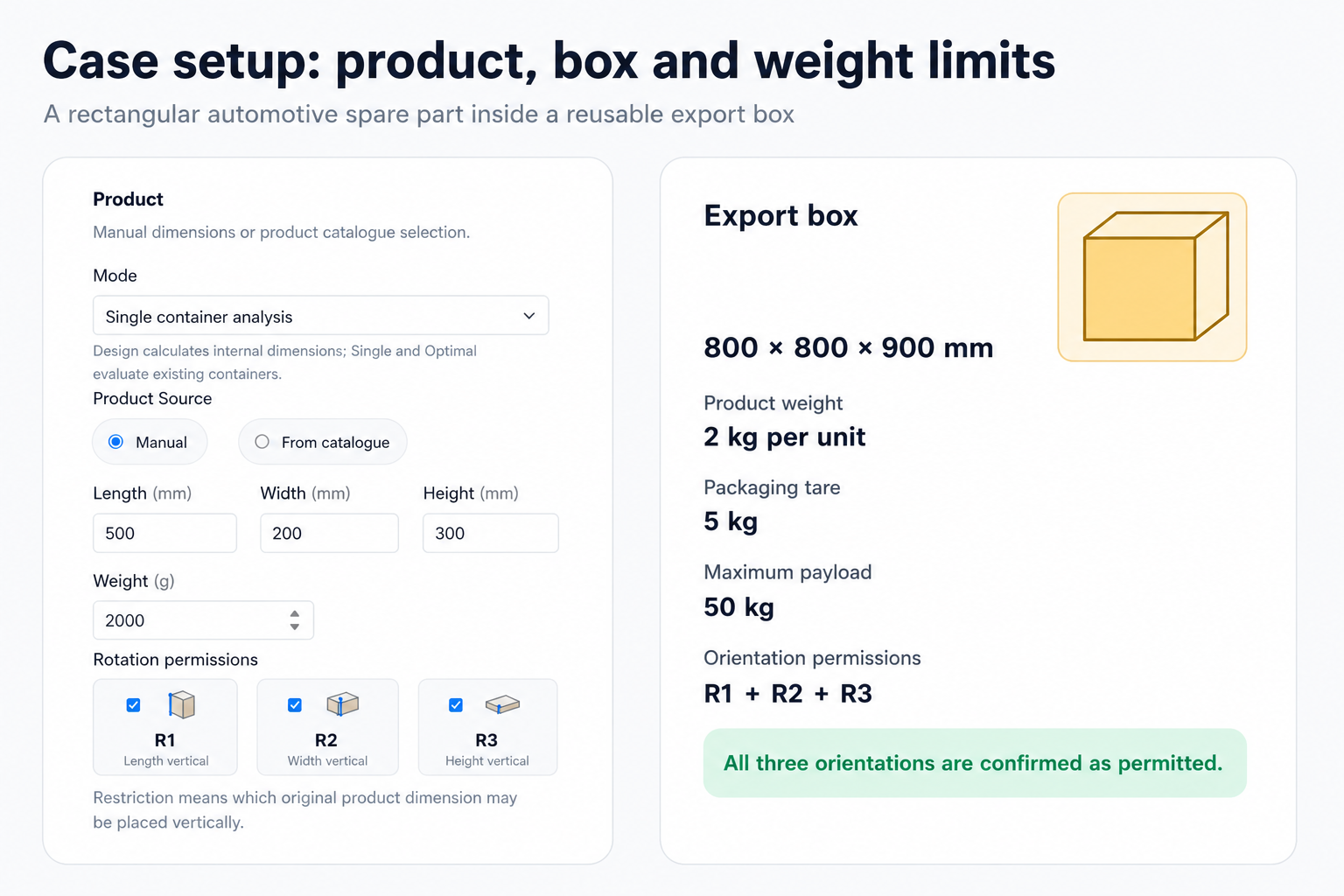
The component measures 500 × 200 × 300 mm and weighs 2 kg. The usable space inside the plywood box is 800 × 800 × 900 mm. The box tare is 5 kg, and the permitted product payload is 50 kg.
After reviewing support conditions, the product and packaging team judges all three upright orientations permissible. That decision is made by the people responsible for the product; KolliPack then compares the geometry that those confirmed permissions allow.
Why the obvious arrangement was not the best one
R1, R2, and R3 are simply the three ways the original product dimensions can be placed vertically: length vertical, width vertical, or height vertical. They are not automatic safety permissions. For a product with an opening, liquid, delicate feature, or unsupported area, one or more may be unsuitable.
Here, using only the familiar height-vertical position (R3) looks credible: 15 products fit and the box is 78% full by volume. But it is not the maximum arrangement. Once KolliPack may use all the confirmed positions in the remaining spaces, capacity rises to 18 and volumetric efficiency to 94%.
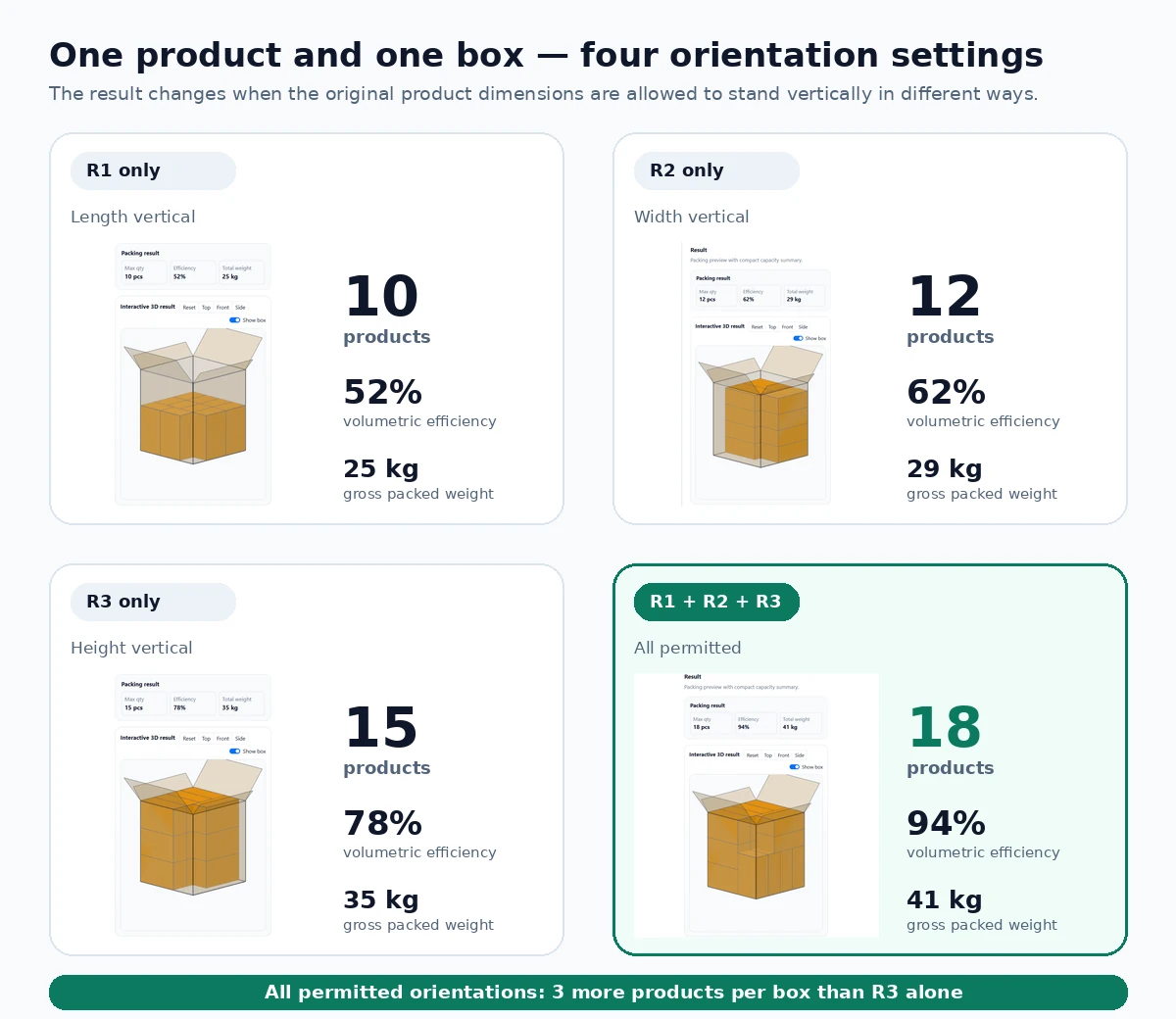
The four calculated comparisons are useful because they make the decision visible:
| Setting | Products | Volume used | Gross packed weight |
|---|---|---|---|
| R1 only | 10 | 52% | 25 kg |
| R2 only | 12 | 62% | 29 kg |
| R3 only | 15 | 78% | 35 kg |
| All permitted orientations | 18 | 94% | 41 kg |
Geometry wins here, not payload
The maximum arrangement contains 36 kg of product. With the 5 kg packaging tare, the gross packed weight is 41 kg. Product payload use is 72% of the 50 kg limit, so available space—not allowable payload—is the limiting condition in this case.
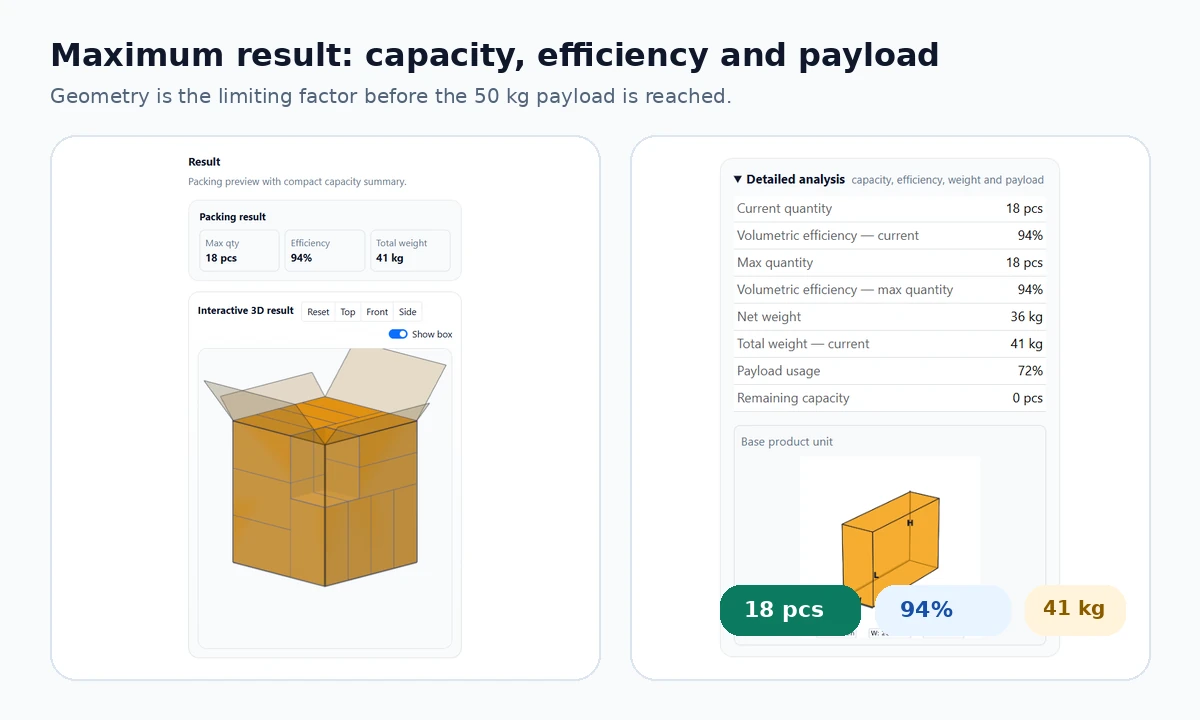
That distinction matters. A different product could have unused space but no remaining payload. A sound box-size calculation checks both before a specification is carried forward.
Three products become fewer boxes when the order repeats
The improvement is small at one-box level, but repeated packing habits can propagate into purchasing, handling, storage, and logistics. For an illustrative order of 1,800 products, 15 per box requires 120 boxes; 18 per box requires 100. That is 20 fewer boxes to buy, handle, store, and move for the same product quantity.
It is not a cost or sustainability claim: protection, material choice, handling, palletization, transport, and customer requirements still determine the real outcome. The business lesson is narrower and useful—standardizing the calculation makes it less likely that a familiar orientation becomes an untested assumption.
Use the calculation to challenge the first answer
KolliPack contributes a repeatable comparison: enter the product and usable box dimensions, confirm the orientations that are truly allowed, then review capacity alongside weight and payload. It does not grant the permissions or replace a physical packaging review.
Open this prepopulated box packing calculation in KolliPack to compare R1, R2, R3, or any permitted combination. The case opens in a new tab so you can change the assumptions without losing this explanation.
Practical takeaway
The right question is not “does the product fit upright?” It is “which positions are genuinely permitted, and what capacity do they create together?” In this representative automotive-service case, that question changes the answer from 15 to 18 products per box.