
When two boxes hold the same internal volume, it is easy to assume they require approximately the same quantity of corrugated board. That assumption is wrong. Equal volume does not mean equal blank area. Even when internal L × B × H dimensions match exactly, changing the structural construction can change how much board remains in the box. Geometry therefore influences material mass, purchasing cost and material-related environmental impact before a supplier quotes the unit price.
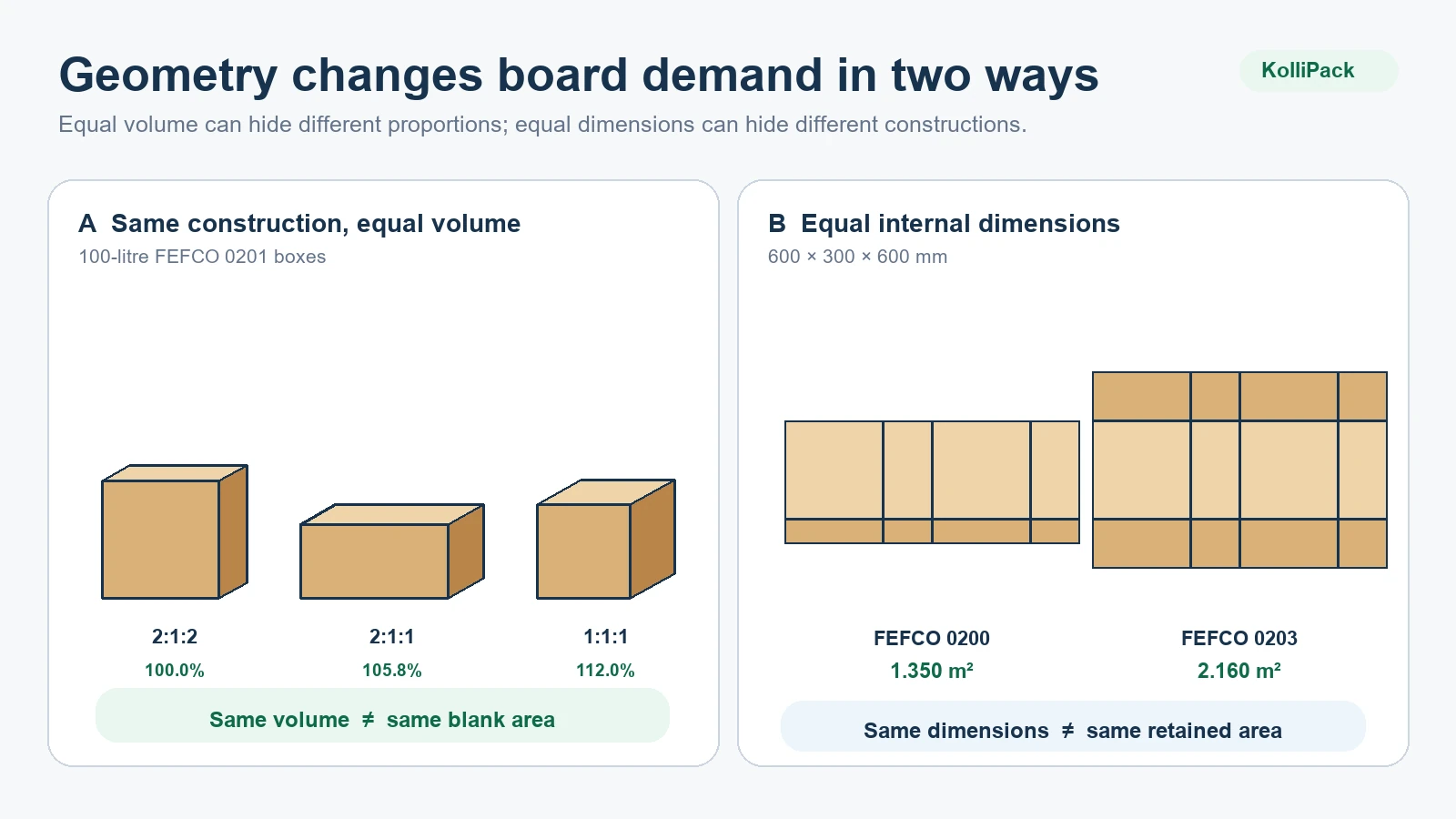
The two ways geometry changes material consumption
Same construction, different proportions
Take two Regular Slotted Containers—FEFCO 0201 boxes—with the same internal volume. If their length, breadth and height proportions differ, the dimensions of their unfolded blanks differ too.
\[ \text{Same volume} \neq \text{same blank area} \]
This comparison changes only the proportions. The construction remains FEFCO 0201.
Same internal dimensions, different construction
Now hold the internal L × B × H dimensions constant. A half-slotted container, a regular slotted container and a construction with longer or overlapping flaps can enclose the same usable space while retaining different quantities of board in their panels and flaps.
\[ \text{Same internal dimensions} \neq \text{same material consumption} \]
The extra material may deliver necessary closure, protection or strength. The important point is that it exists and should be evaluated.
Why FEFCO 0201 is a useful mathematical example
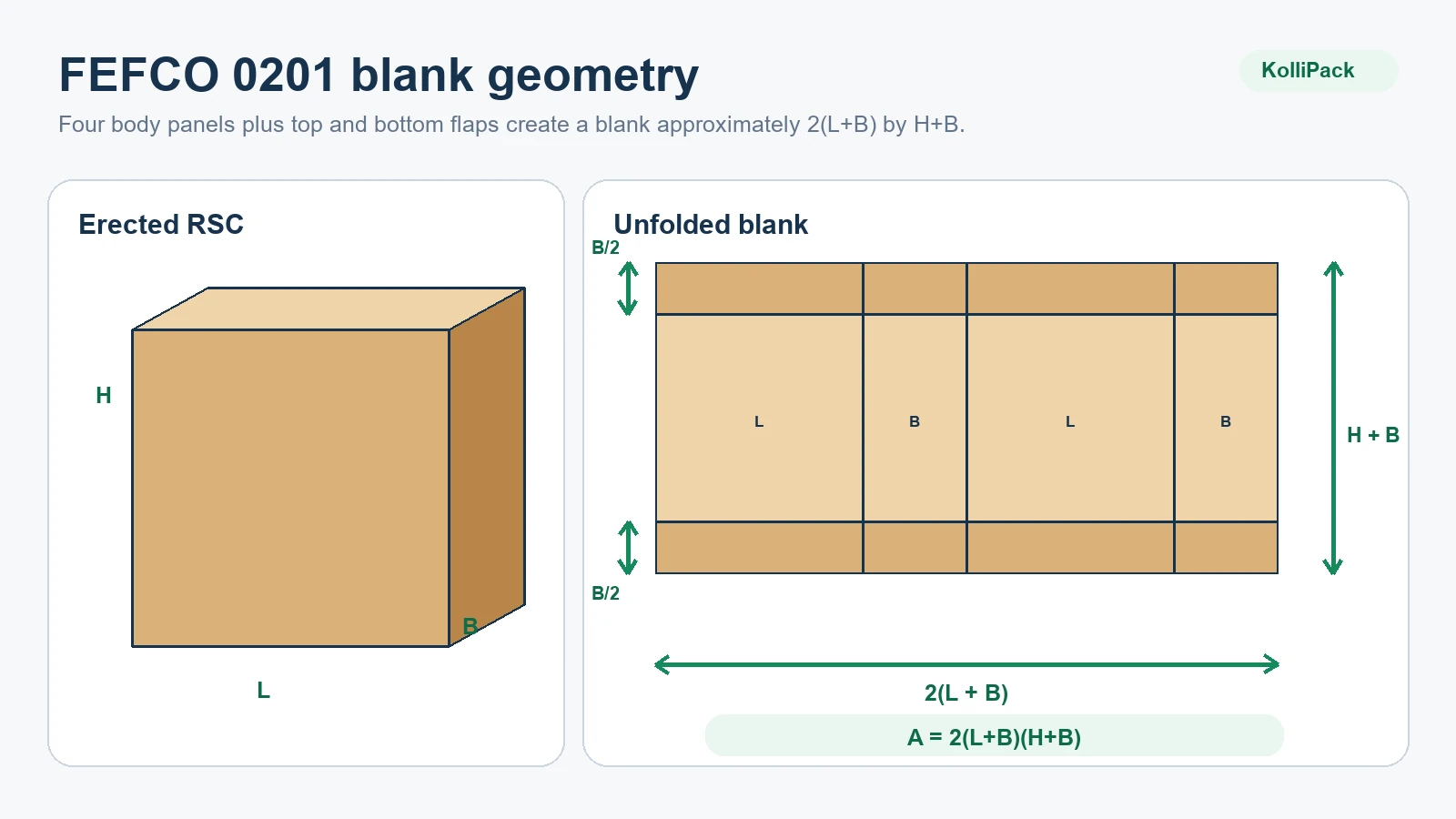
FEFCO 0201, commonly called a Regular Slotted Container or RSC, has four connected body panels plus top and bottom slotted flaps. Its major flaps meet approximately at the centre of the shorter opening dimension.
The FEFCO dimension convention defines:
- \(L\) as the longer opening dimension;
- \(B\) as the shorter opening dimension; and
- \(H\) as the internal height.
The simplified 0201 blank is approximately:
Blank length = 2(L + B)
Blank width  = H + B
The width includes the body height plus two flap depths:
B/2 above the body
+
B/2 below the body
=
B
This model intentionally ignores the manufacturer's joint, score allowances, board-thickness corrections and dimensional tolerances. Those details matter in a supplier drawing, but they do not change the theoretical relationship derived here. The construction geometry is verified against the 12th-edition FEFCO Code.
Deriving the FEFCO 0201 material minimum
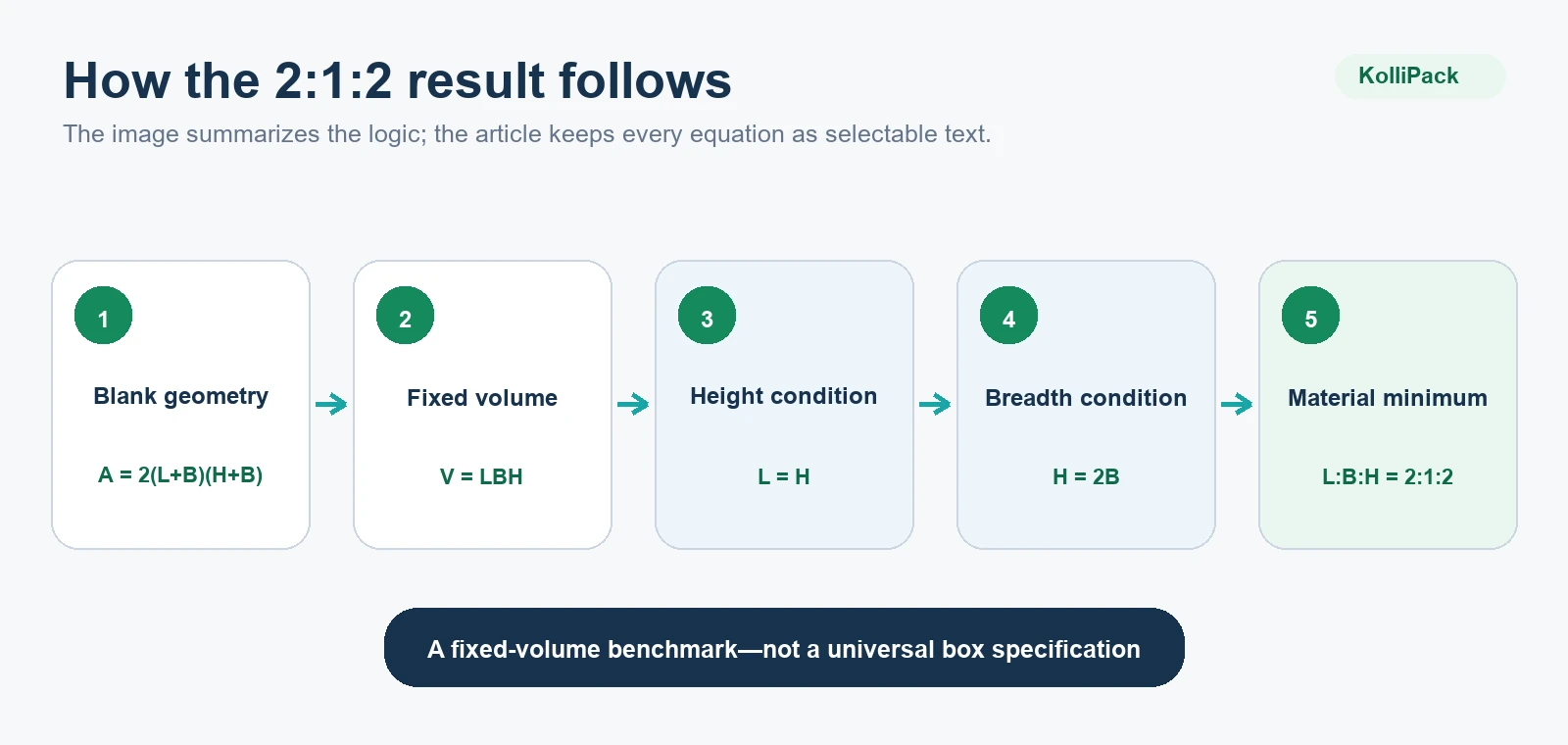
Only the simplified FEFCO 0201 construction is derived in full. The purpose is not calculus for its own sake; it is to show why volume alone cannot predict board demand.
Step 1 — Express the blank area
\[ A=2(L+B)(H+B) \]
Here, \(2(L+B)\) is the perimeter length of the four connected body panels, \(H+B\) is the body height plus both flap depths, and \(A\) is the simplified theoretical blank area.
Step 2 — Keep internal volume fixed
\[ V=LBH \]
Solving for length gives:
\[ L=\frac{V}{BH} \]
Step 3 — Substitute volume into the area equation
\[ A=2\left(\frac{V}{BH}+B\right)(H+B) \]
Expanding:
\[ \frac{A}{2}=\frac{V}{B}+\frac{V}{H}+BH+B^2 \]
The area is now described by \(B\), \(H\) and the fixed volume \(V\).
Step 4 — Differentiate with respect to height
\[ \frac{\partial(A/2)}{\partial H}=-\frac{V}{H^2}+B \]
At the minimum:
\[ -\frac{V}{H^2}+B=0 \]
Therefore:
\[ V=BH^2 \]
Because \(V=LBH\), it follows that:
\[ L=H \]
In ordinary language: at the theoretical material minimum, box length and height are equal.
Step 5 — Differentiate with respect to breadth
\[ \frac{\partial(A/2)}{\partial B}=-\frac{V}{B^2}+H+2B \]
At the minimum:
\[ -\frac{V}{B^2}+H+2B=0 \]
Using the previous relationship gives:
\[ H=2B \]
Because \(L=H\):
\[ \boxed{L:B:H=2:1:2} \]
This is the simplified theoretical material minimum for FEFCO 0201 at a fixed internal volume.
Why the cube is not the minimum-material RSC
A cube minimizes the surface area of a simple closed cuboid. An RSC is not merely six independent rectangular surfaces: its top and bottom flaps are linked to \(B\), the shorter opening dimension.
Increasing \(B\) increases the body perimeter and the depth of both flap sets. If \(B\) becomes very small, \(L\) or \(H\) must grow to preserve volume. If \(H\) becomes very small, the footprint must grow. If \(B\) becomes large, both body and flap material increase. The 2:1:2 relationship is the point where these effects balance in the simplified model.
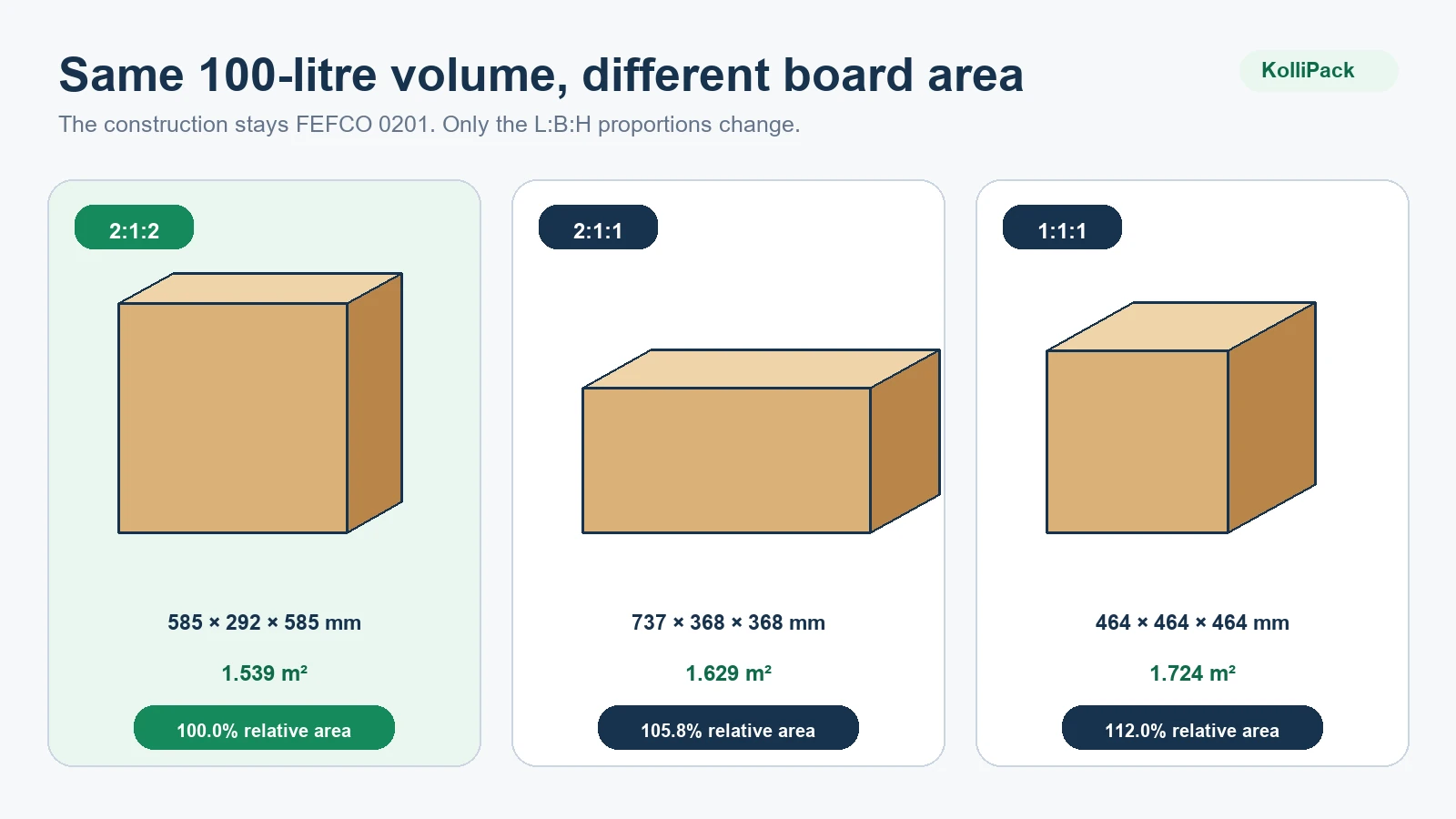
Controlled comparison: three 100-litre RSCs
The effect becomes tangible when the construction and volume stay fixed. The dimensions below are independently scaled to exactly 100,000,000 mm³ before rounding for display.
All three boxes provide approximately 100 litres and use the same FEFCO 0201 construction. Only their proportions change. In this controlled theoretical comparison, the short 2:1:1 box needs about 5.8% more blank area than 2:1:2, while the cube needs about 12.0% more. These are not universal production savings; they are the consequence of the stated geometry and assumptions.
Same internal dimensions, different construction
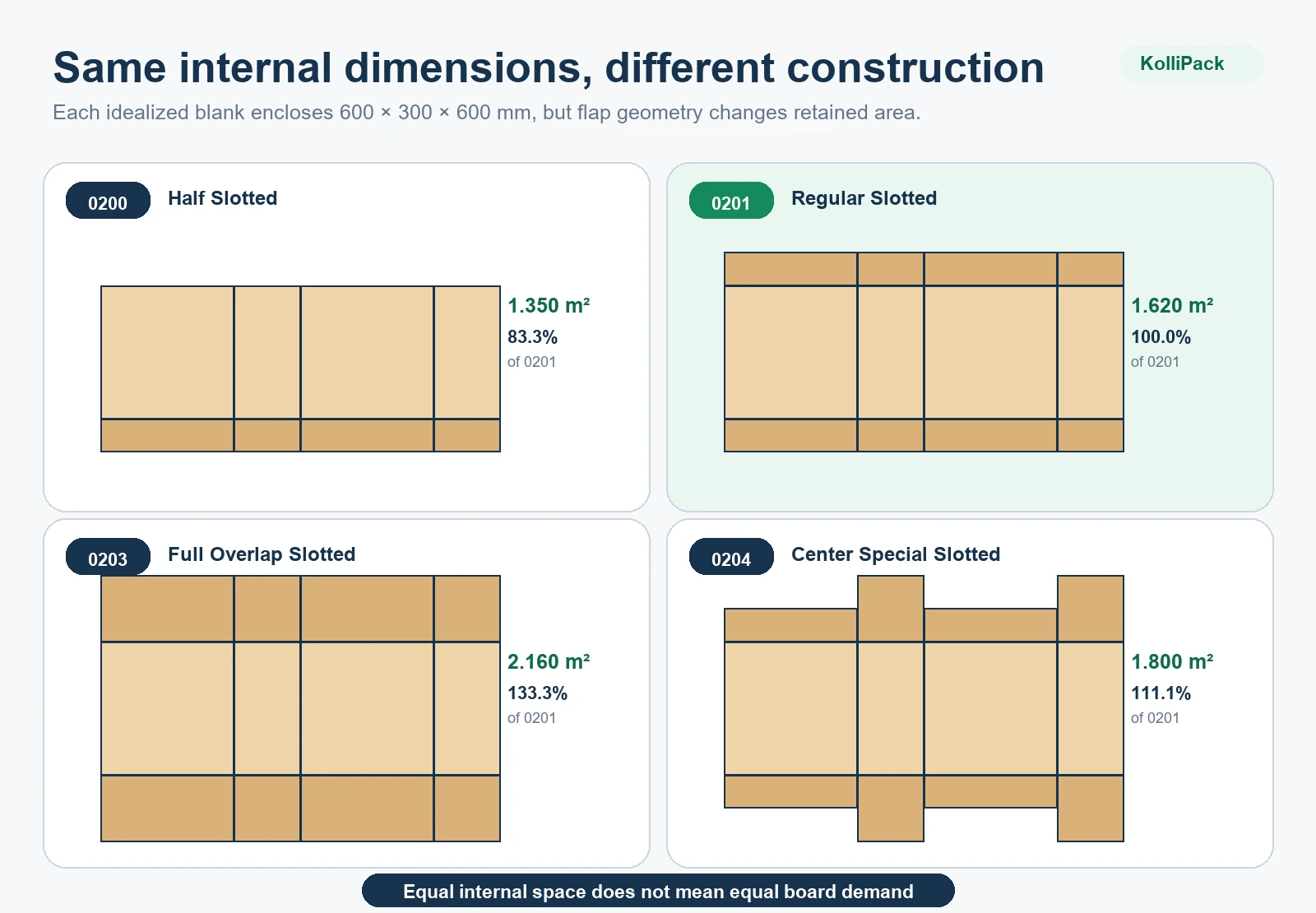
The second mechanism appears even when the usable internal space does not change. For a controlled 600 × 300 × 600 mm internal size, the official FEFCO panel and flap geometry gives the following simplified retained areas:
These values exclude the same small allowances used in the 0201 derivation. They compare board retained in the idealized structure, not supplier pricing. Each construction provides different closure and performance, so the lowest-area row is not automatically the right choice.
Two boxes with identical internal dimensions can consume different quantities of corrugated board because their structural constructions are different.
Different constructions create different material optima
The same simplified fixed-volume method can be applied to other slotted constructions. Their distinct unfolded geometries produce distinct theoretical optima:
These are idealized material-area relationships derived from the FEFCO flap geometry without production allowances. Only 0201 receives a detailed derivation here. The broader lesson is simple: each construction has a different unfolded geometry, so each creates a different material optimum.
From board area to material, purchasing cost and carbon impact
For a fixed board construction and combined grammage:
\[ m=A \times g \]
where \(m\) is approximate corrugated-board mass, \(A\) is blank area and \(g\) is combined board grammage. FEFCO's corrugated-board production guidance likewise calculates sheet weight from area and grammage.
When board grade, flute structure, grammage, moisture assumptions and production allowances remain constant, a percentage change in blank area should produce a similar percentage change in finished board mass.
Material consumption
More retained blank area normally means more corrugated board per box and more empty-packaging weight to handle.
Purchasing cost
Board is an important part of corrugated-box cost, so geometry belongs in quotation requests, supplier comparisons, standardization work and reviews of inherited specifications. Unit price will not move in exact proportion to area: printing, setup, order quantity, logistics and supplier pricing also matter.
Material-related carbon impact
Lower board area can reduce material demand and its associated material-related carbon impact. It can reduce the material tied to paper production, corrugating, empty-packaging transport and handling.
That does not mean a 10% blank-area reduction automatically creates a 10% reduction in the complete packaging-system carbon footprint. Product damage, compression performance, pallet and transport utilization, additional packaging components and recycling assumptions can change the total result.
What a buyer or packaging engineer should ask
The box price quotation is not the beginning of the decision. Geometry has already influenced how much material is being purchased.
- Are the internal dimensions driven by the product, or inherited from an older specification?
- Could the required volume be achieved with more material-efficient proportions?
- Has the selected FEFCO construction been compared with functional alternatives?
- How much retained board area does each proposal require?
- Is additional material providing necessary protection, closure or strength?
- How does each geometry affect the pallet pattern and pallet height?
- How does it affect truck or container loading?
- Does a local material reduction create a worse logistics result downstream?
Minimum area is not the complete packaging decision
\[ \text{Minimum theoretical board area} \neq \text{best complete packaging solution} \]
Material area is one objective inside a multi-objective engineering decision. Product dimensions and orientation, quantity per box, headspace, protection, board strength, compression, stack height, filling and closing machinery, ergonomics, stability, pallet dimensions and transport-unit dimensions can all change the preferred design.
Experimental packaging research also shows that construction details affect strength and cost, which is why physical box-compression testing and supplier validation remain necessary. A design near 2:1:2 may be a strong material benchmark and still be a poor fit for the product, machine, pallet or distribution environment.
How KolliPack supports the decision
The useful decision chain is:
Product dimensions and quantity → box geometry and construction → material demand → palletization → transport loading → final packaging decision
KolliPack can help identify and compare promising alternatives across product arrangement, required internal dimensions, RSC proportions, quantity per box, pallet quantity, pallet height and transport utilization. Its value is not merely calculating a box. It is making the trade-offs between material-efficient geometry, practical packaging performance and logistics performance visible before supplier quotations, physical samples and validation testing.
Use the KolliPack Box Size Calculator to explore product-to-box geometry, then assess shortlisted alternatives through Packaging Flow when pallet and transport consequences matter.
KolliPack does not certify compression strength, carbon footprint, compliance or a universally optimal package. Those conclusions require supplier specifications, physical samples, testing and the business assumptions of the real distribution system.
The decision to carry forward
Box volume, dimensions, board grade and quoted price do not tell the complete material story. Proportions determine the area of a given construction; construction determines which panels and flaps are retained. Both can affect material mass, purchasing cost and material-related environmental impact.
For FEFCO 0201, the simplified fixed-volume benchmark is \(L:B:H=2:1:2\). Use it as a reference point, not a universal specification. The stronger decision is the geometry that meets product and operational requirements while producing the best combined material, pallet and transport result.
References
- FEFCO Code: Design Style Library for Corrugated Board Products, 12th edition.
- FEFCO Recommendation No. 101: Procedure for Determining Internal Dimensions.
- FEFCO European Database: Corrugated Board Production.
- Günal Ertaş, D. and Torgay Dönmezer, B. (2025). The Effect of Industrial Design on Corrugated Cardboard Packaging Optimization. Archives of Design Research, 38(2), 45–69.