
One attractive 12-unit shipping box carried 9,600 products per 40-foot high-cube container. Other box designs for the same product carried 14,400. The 4,800-product difference did not come from changing the retail pack, pallet, or transport unit; it came from following the box decision through the whole packaging flow.
This is why packaging flow optimization starts with a box but cannot end there.
The decision behind the case
Consider a rectangular household-care retail pack, such as a boxed cleaning or personal-care product, supplied to a large supermarket chain. This is a representative category, not a named retailer, brand, or customer requirement. Products move on Euro pallets to a central distribution centre and then onward to stores, so the pallet arrangement matters as much as the individual shipping box.
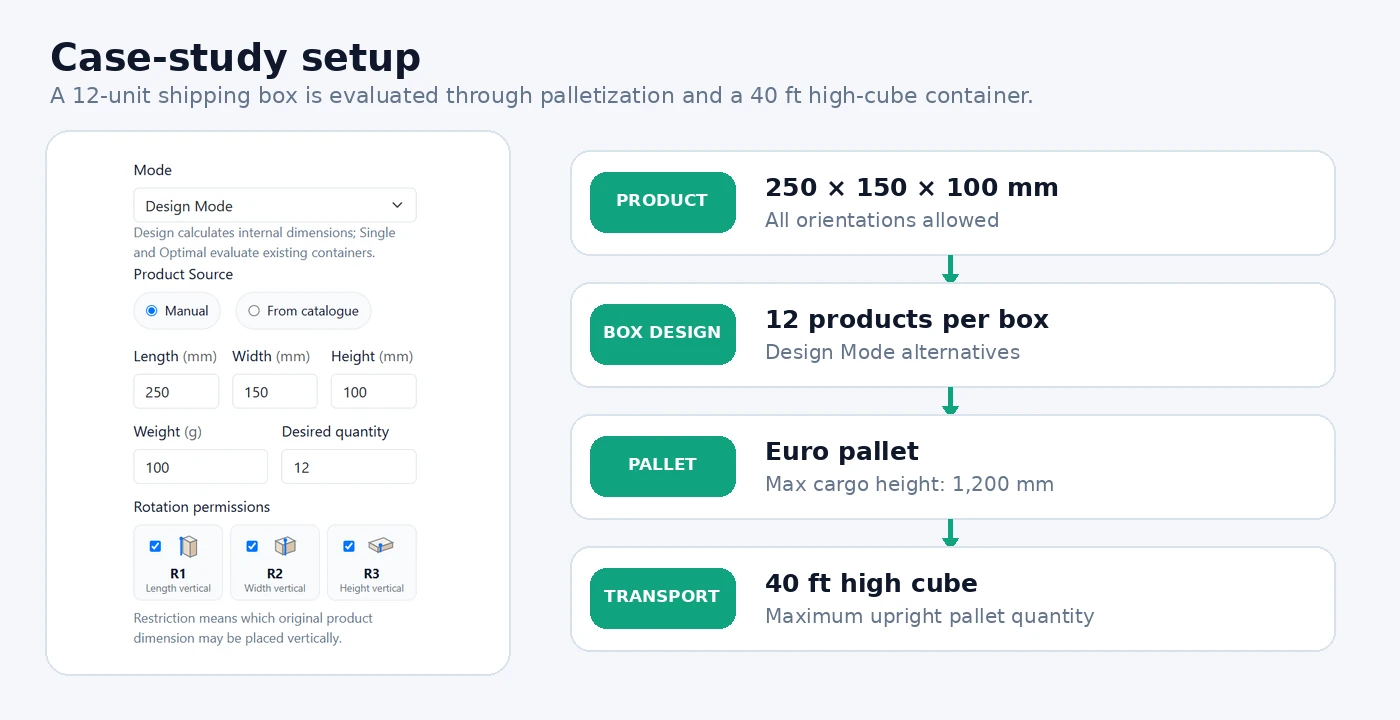
Each retail unit measures 250 × 150 × 100 mm. The brief calls for 12 units per shipping box, with all orientations allowed. KolliPack evaluates box designs, a 1,200 × 800 mm Euro pallet with a 1,200 mm maximum carton stack height, and a 40-foot high-cube dry container.
The apparent answer: a compact-looking box
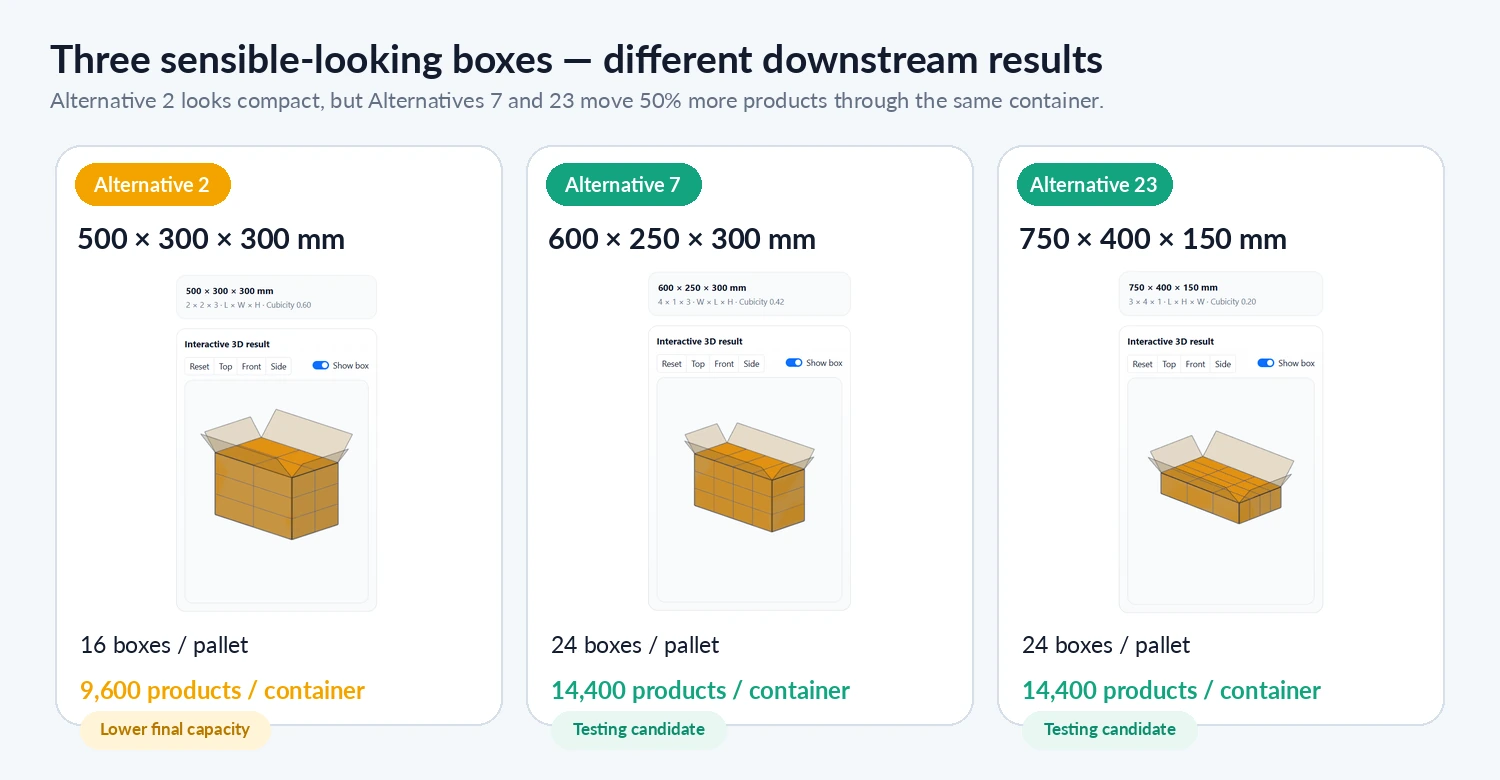
A 500 × 300 × 300 mm proposal appears tidy and compact. It contains the requested 12 products and is a plausible first answer when looking only at the box.
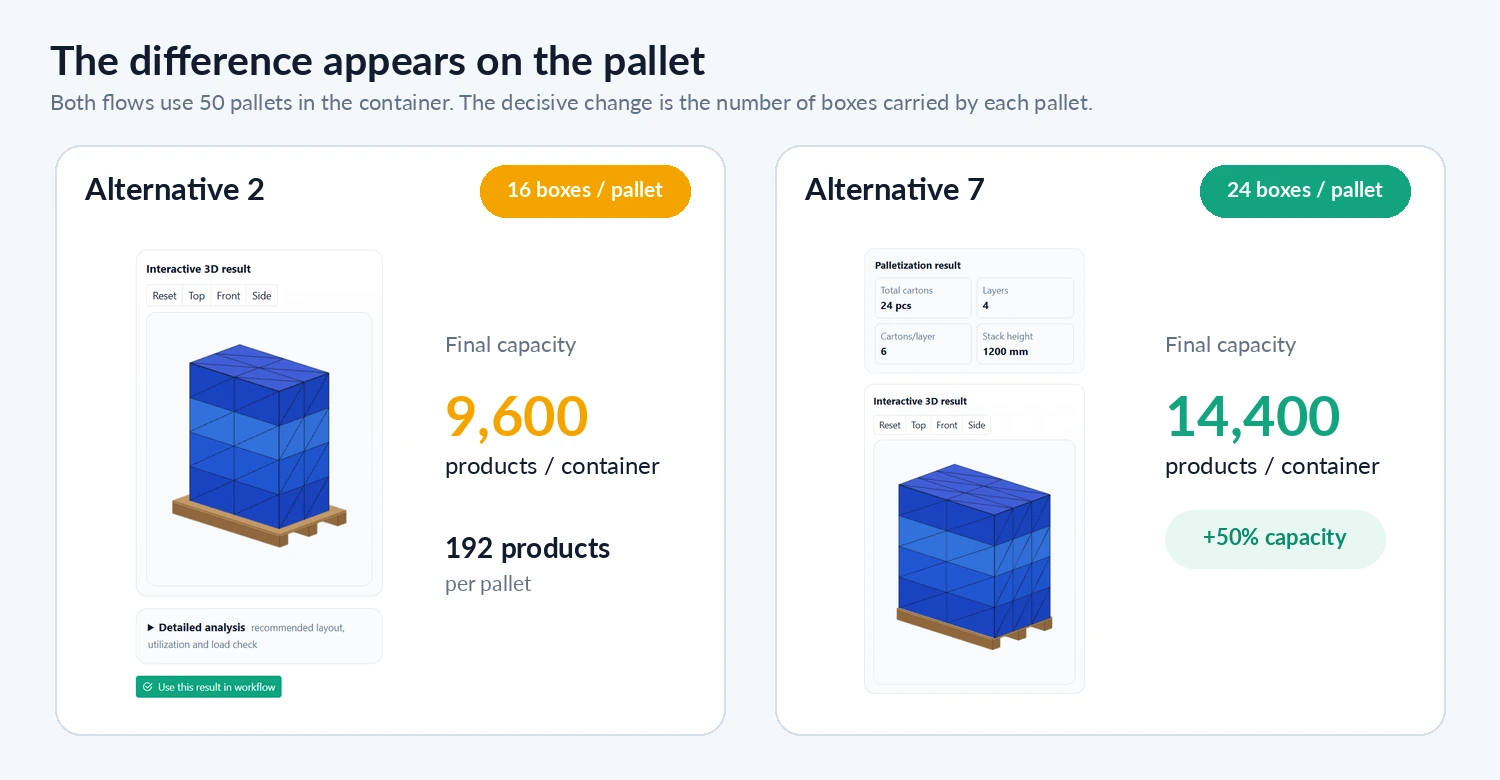
The downstream result tells a different story: it places 16 boxes on each pallet, or 192 retail products, and 50 palletized loads in the container. The final capacity is 9,600 products.
The pallet changed the final result
Alternatives 7 and 23 both reach 24 boxes per pallet, while the compact proposal reaches 16. Since all three results use 50 palletized loads per high-cube container, the pallet improvement carries directly through to the final transport quantity.
| Metric | Compact proposal | Alternative 7 | Alternative 23 |
|---|---|---|---|
| Box dimensions | 500 × 300 × 300 mm | 600 × 250 × 300 mm | 750 × 400 × 150 mm |
| Products per box | 12 | 12 | 12 |
| Boxes per pallet | 16 | 24 | 24 |
| Products per container | 9,600 | 14,400 | 14,400 |
The container confirms the business consequence
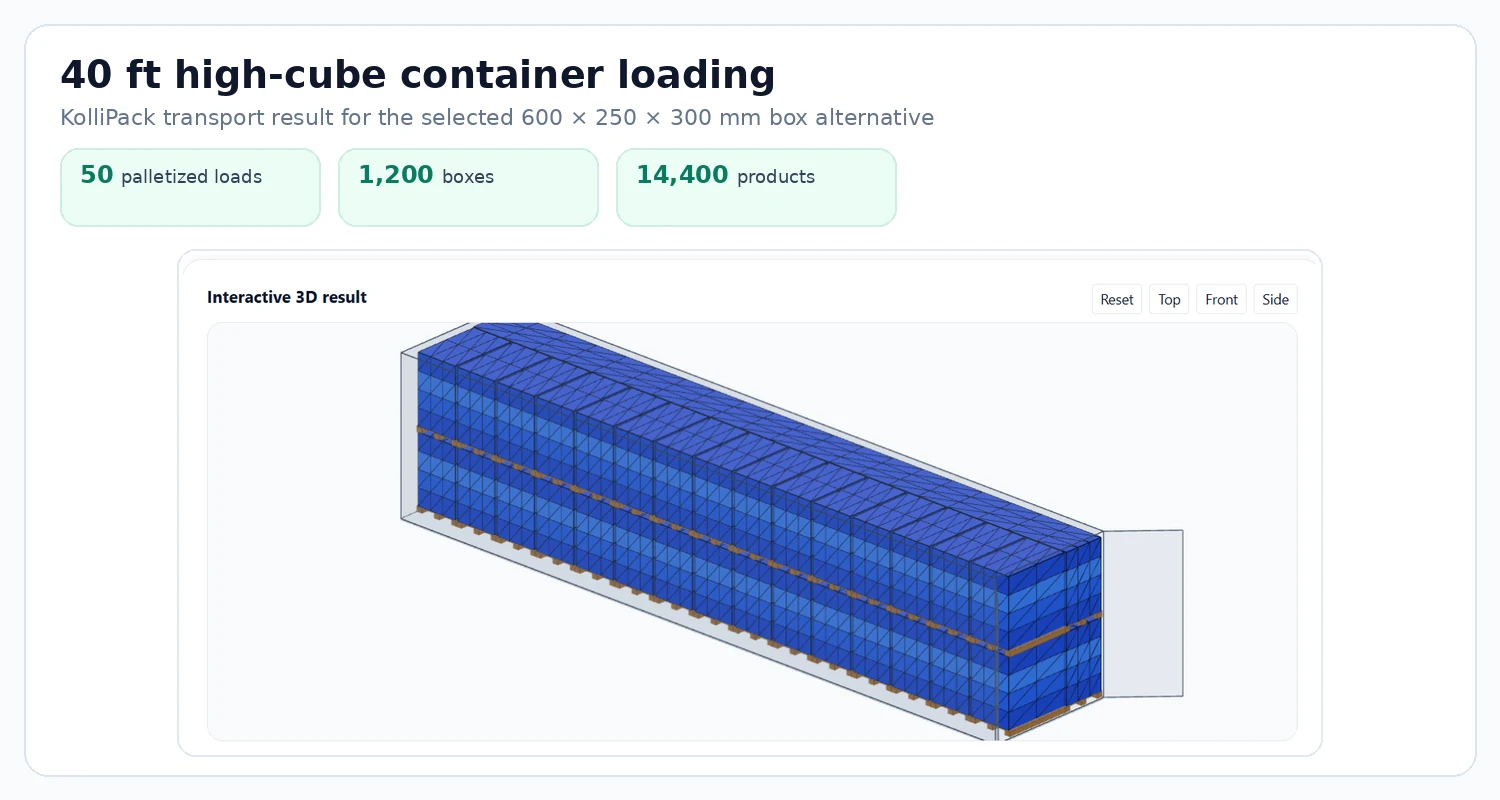
For Alternative 7, the transport result is 50 palletized loads, 1,200 shipping boxes, and 14,400 retail products. The transport image matters because it closes the chain: the better pallet result survives into the final loading decision.
Maximum capacity is a shortlist, not a final specification
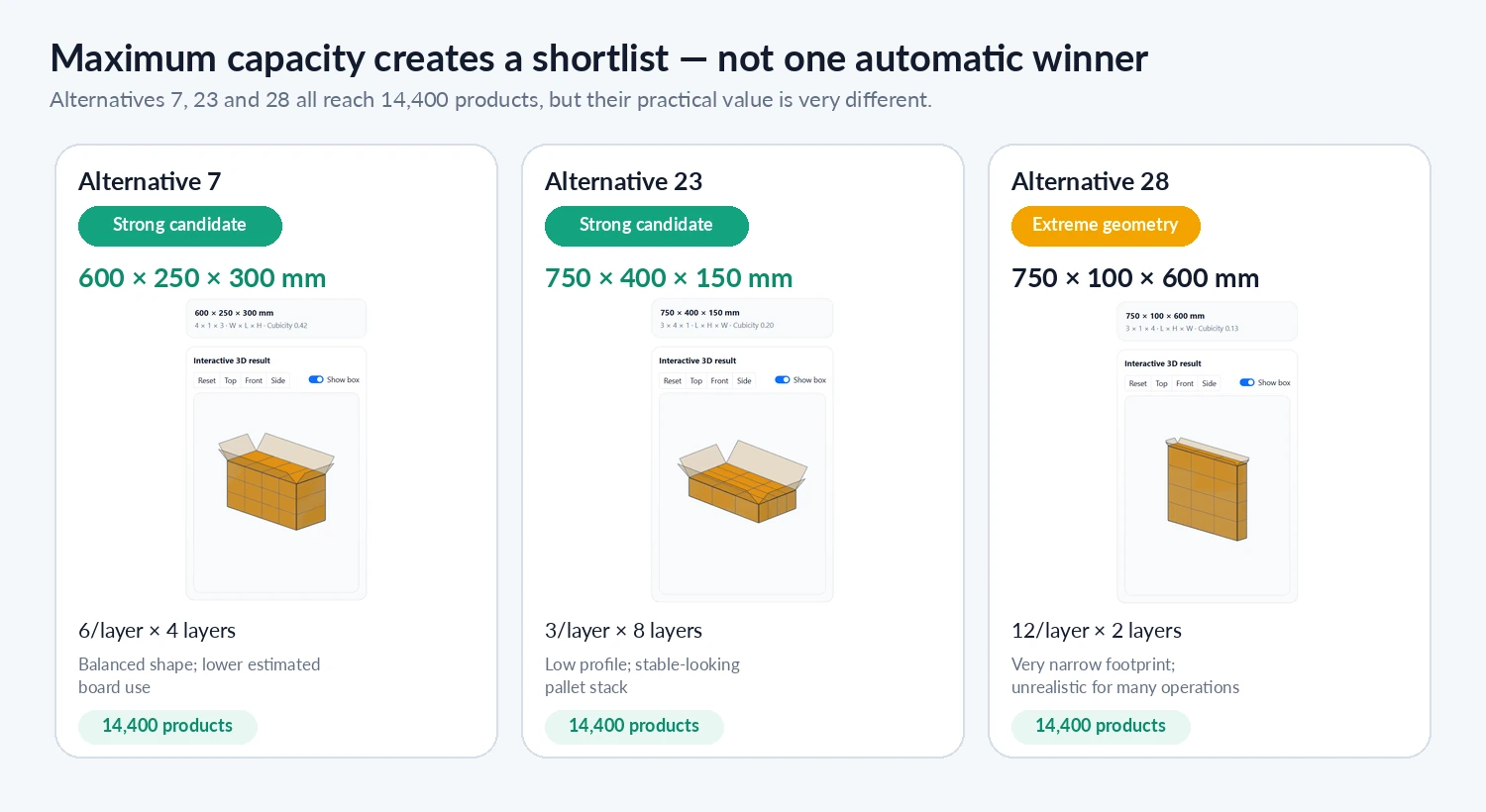
The maximum result does not make every 14,400-product design equally suitable. Alternative 6 has a tall profile that warrants stability, filling, closing, compression, and handling checks. Alternative 28 is mathematically efficient but very narrow and tall, making it operationally unrealistic for many settings.
Alternatives 7 and 23 are stronger candidates for physical and operational testing: both reach the maximum calculated transport capacity with more balanced, explainable geometries. They are candidates, not certified winners.
Material use can separate tied candidates
The case retains a secondary comparison for an idealized regular slotted corrugated box. Under the same simplified assumption, Alternative 7 has an estimated blank area of about 0.94 m², compared with about 1.27 m² for Alternative 23—roughly 26% less board area.
That is a useful selection question, not a supplier quote or proven saving. Final blank dimensions, board grade, joints, inserts, product protection, equipment, handling, stability, and physical testing still decide the specification.
Explore the exact flow
KolliPack makes the connected calculation visible: select a box alternative and review its effect on the pallet and transport result. It helps turn many possible box geometries into a small, explainable shortlist for supplier drawings, samples, and tests.
Open this prepopulated Packaging Flow case in KolliPack and compare the alternatives in a new tab.
Practical takeaway
The first box was not wrong—it simply answered only the first question. End-to-end evaluation revealed a 9,600-versus-14,400 product contrast and highlighted Alternatives 7 and 23 for the next stage of work.