
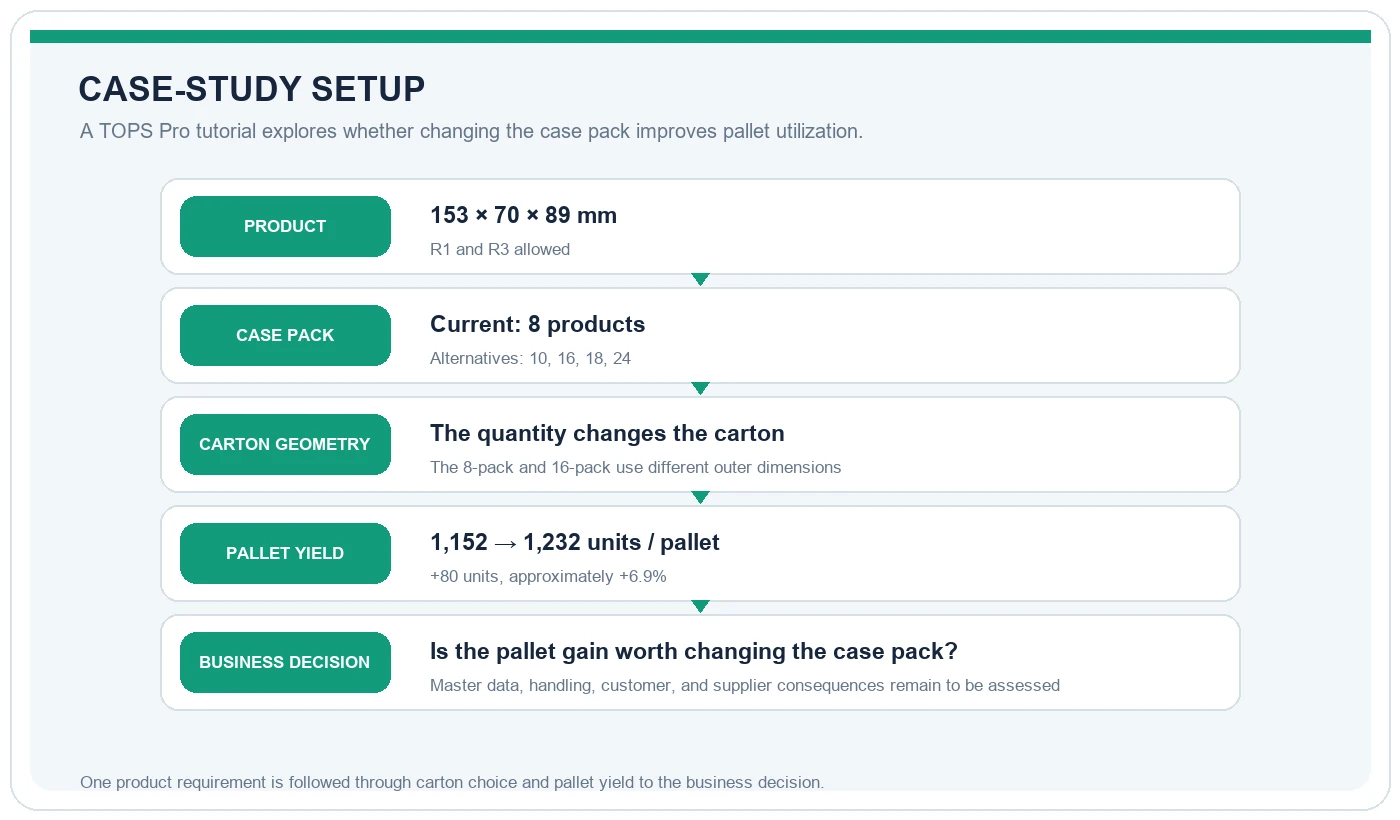
In this article, we analyze the case-pack optimization example shown in a public TOPS Pro tutorial. The question is familiar to packaging, purchasing, and engineering managers: if a company ships 1,000,000 products per year in 8-unit cartons, can increasing the quantity per carton reduce pallet and container demand?
The tutorial moves from 1,152 to 1,232 products per pallet—an increase of 80 products, or about 6.9%. At the illustrative annual volume, that is approximately 57 fewer pallets per year. If a high-cube container carries 50 pallets, the improvement represents roughly one fewer container per year. The calculation in this article stops at the pallet; the container comparison simply expresses the business scale of the pallet result.
KolliPack reproduces the same headline capacities in this case. The more useful business question comes next: does the 80-unit gain require changing from 8 to 16 products per case, or can the existing 8-pack reach the same pallet result by testing carton caliper, pallet overhang, or carton geometry?
Comparison scope. TOPS Pro results were reproduced from the public tutorial used for this case. KolliPack is not affiliated with or endorsed by TOPS Software Corporation. This article compares one palletization case and does not represent a complete product evaluation.
The business question behind the case
The TOPS Pro case presents a generic brand-owner scenario rather than a named company or product. The company is already shipping a product in an 8-unit carton and wants to know whether a larger case pack would improve pallet utilization. The tool compares 8, 10, 16, 18, and 24 products per carton, then identifies the 16-pack as the strongest result for the demonstrated pallet case.
The one-million-product volume is an illustration from the case, not a forecast for a particular company. It is useful because it turns a pallet calculation into a decision that a manager can recognize: whether a packaging change could remove a recurring logistics requirement.
For a packaging or purchasing manager, the decision is familiar. A higher case pack may improve logistics, but it also changes the shipping specification that customers, warehouses, suppliers, and internal systems use. The calculation is therefore a screening step before a packaging change, not the whole approval decision.
Setting up the same case in TOPS Pro and KolliPack
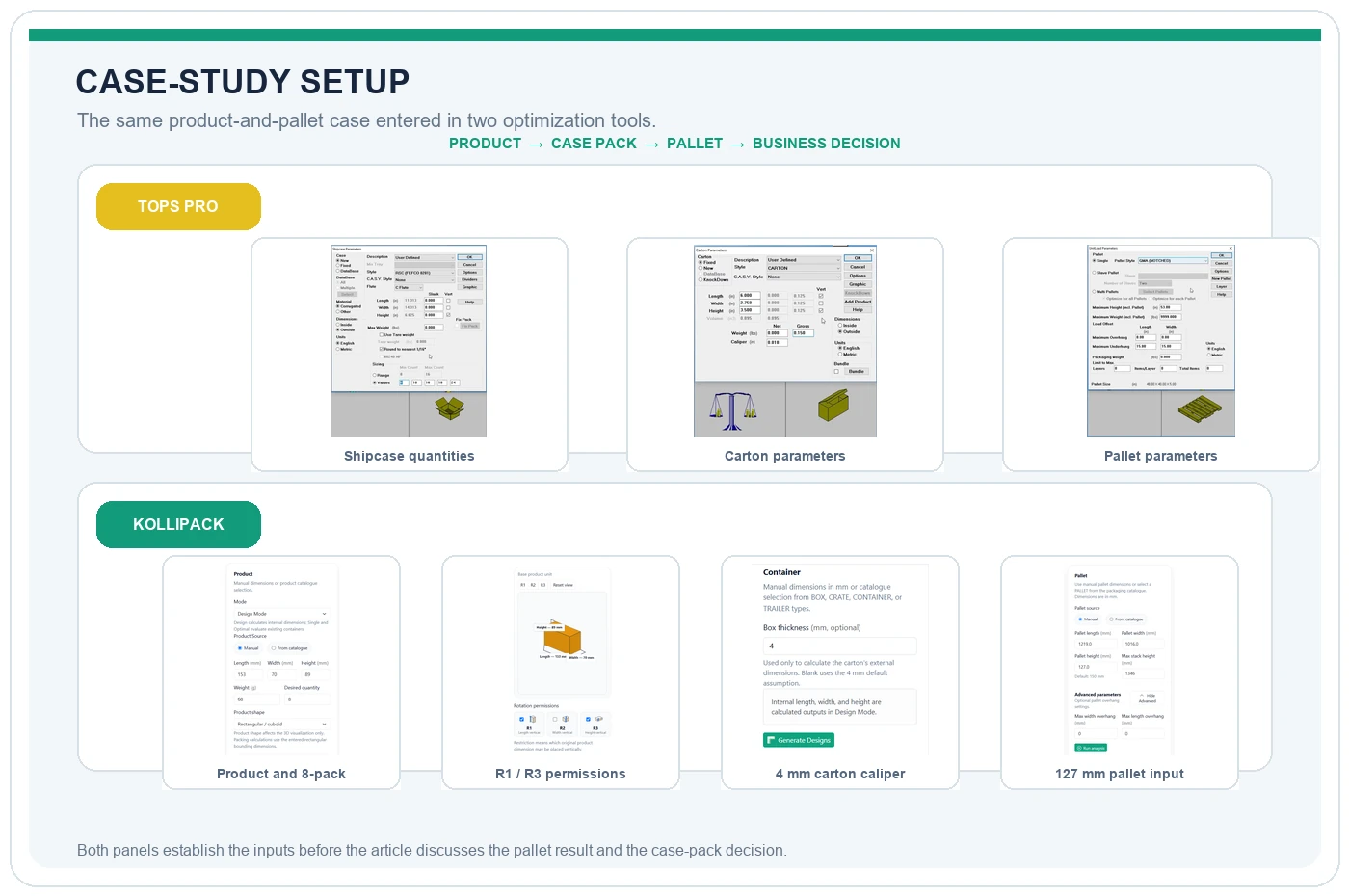
The product in the tutorial is approximately 153 × 70 × 89 mm and weighs about 68 g after conversion from the source value. The brand-owner rules allow two permitted upright orientations, represented by R1 and R3 in KolliPack.
The unit load is a 1,219 × 1,016 × 127 mm GMA pallet, with a 1,346 mm maximum total height and zero permitted overhang. For the KolliPack reproduction, the C-flute assumption is represented as a 4 mm carton caliper. The source material does not identify a TOPS version, edition, or region, so this is a comparison of the supplied public result and the reproduced case inputs—not a version-controlled software test.
TOPS evaluates the five quantities together and presents a preferred result. KolliPack exposes the quantities as cases to inspect: the user can generate a carton for 8, 10, 16, 18, or 24 products, review the alternatives, and pass a selected carton to palletization. That is a different interaction model, but it leads to the same practical comparison: how does the case-pack decision change the pallet?
KolliPack matches the TOPS Pro result in this case
The matched outputs are simple to read:
| Case pack | TOPS Pro result | KolliPack result | Pallet detail |
|---|---|---|---|
| 8 products/carton | 1,152 products | 1,152 products | 144 cartons; 24 per layer × 6 layers |
| 16 products/carton | 1,232 products | 1,232 products | 77 cartons; 11 per layer × 7 layers |
The KolliPack reproduction uses matched carton dimensions of approximately 314 × 148 × 194 mm for the 8-pack and 364 × 288 × 169 mm for the 16-pack. The resulting total palletized heights are 1,291 mm and 1,310 mm, both within the stated 1,346 mm limit.
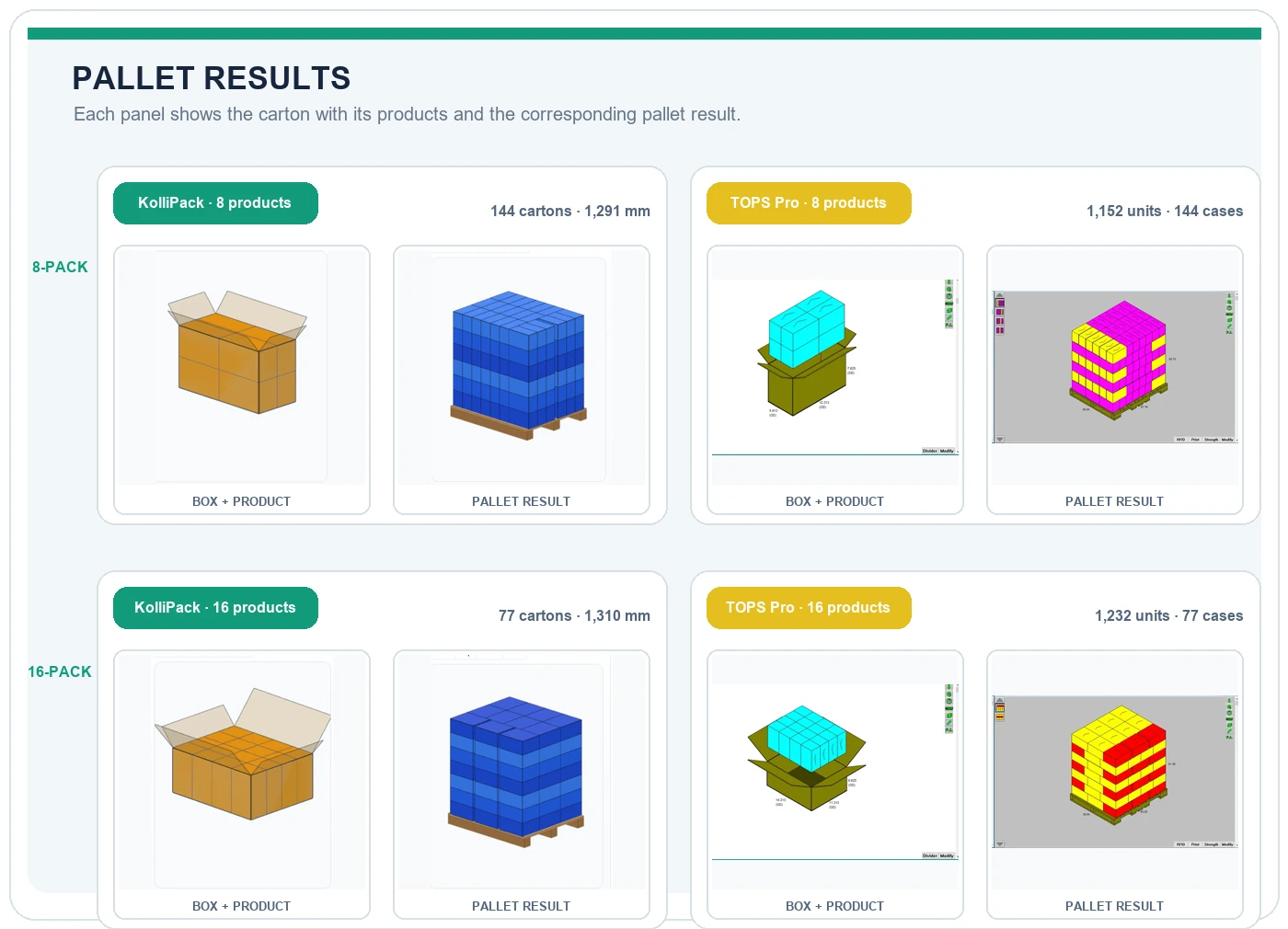
The match is the important result of this case. It shows that KolliPack can reproduce the source tutorial's two headline pallet capacities with the stated assumptions. It does not establish that every feature, ranking convention, or result across either product is identical.
More alternatives make the next question visible
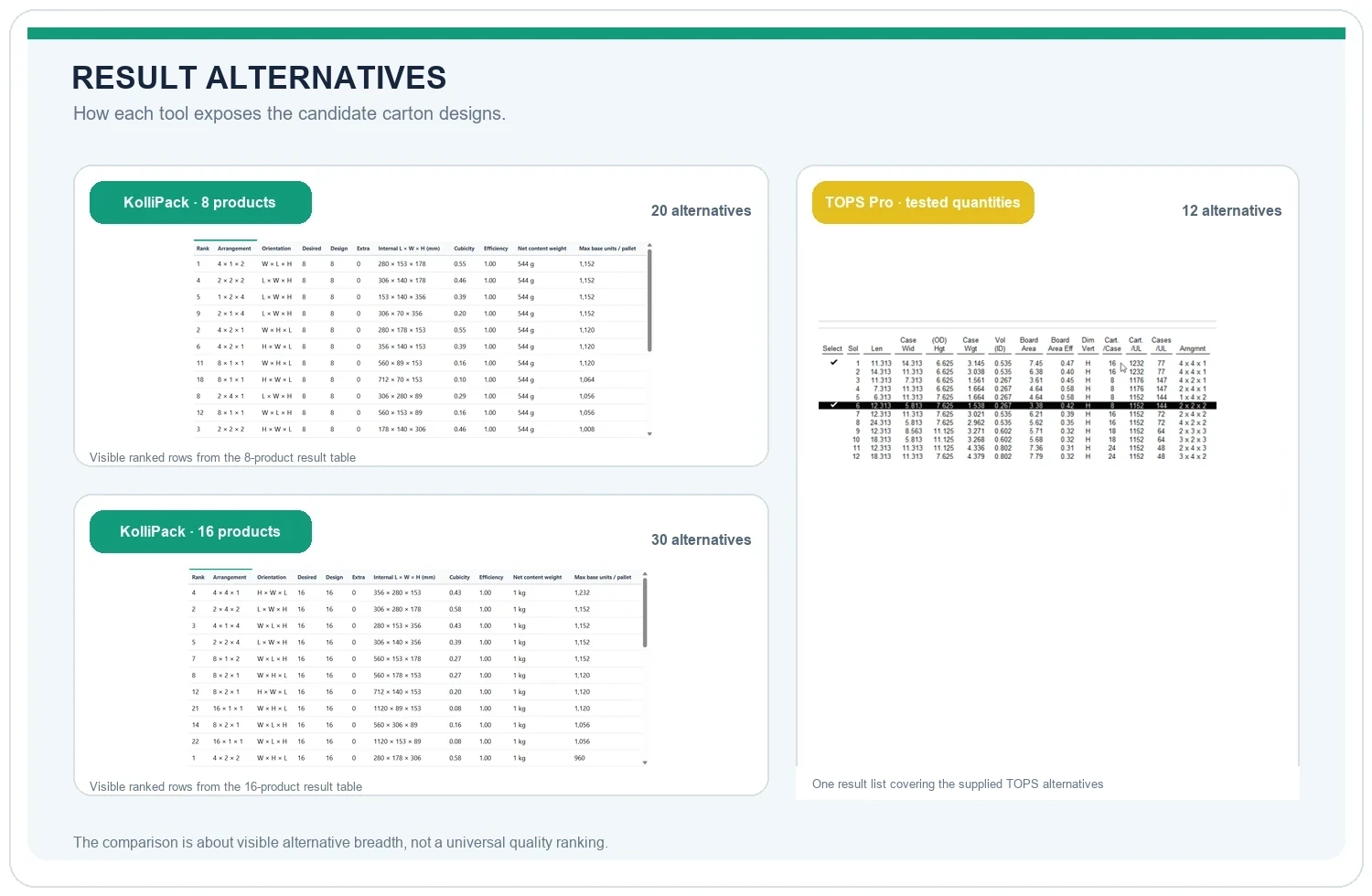
The result tables show another difference in the workflow. The supplied TOPS table presents 12 alternatives for the case comparison. KolliPack generates a broader inspectable list in this case: 20 alternatives for the 8-pack and 30 for the 16-pack.
The count itself is not a score for either tool. It matters because a packaging team may want to look beyond the first highlighted row. Several 8-pack designs can reach the 1,152-unit pallet result, while the leading 16-pack design reaches 1,232. Carton geometry and pallet pattern still matter after the quantity has been chosen.
Should the company change from 8 to 16?
If pallet yield is the only criterion, the 16-pack is attractive. It carries 80 more products per pallet in this case. But changing the case quantity is a packaging-system decision, not a simple data-entry change.
Moving from 8 to 16 may require review of:
- packaging master data, case labels, and barcodes;
- customer, warehouse, and supplier records that use the case quantity;
- case weight, lifting, opening, counting, and storage practices;
- order quantities, inventory levels, and the amount of product held in each case;
- carton equipment, closing, compression, pallet stability, and physical testing.
A larger case can improve pallet yield while being less convenient for a customer or operator. A smaller case can be easier to handle and replenish while requiring more cartons and pallet positions. The correct answer depends on the real supply chain, not only the highest number in the result table.
Now it is your turn: explore this case in KolliPack
The prepopulated KolliPack case opens with the 8-pack baseline and contains only the box-to-pallet calculation: the confirmed 127 mm pallet height, 1,346 mm maximum total height, zero overhang, R1 and R3 product orientations, and the 4 mm C-flute caliper assumption.
Explore this case in KolliPack and change the desired quantity to compare the 8-pack with 10, 16, 18, or 24. Then try the variables that are often fixed too early: pallet overhang, carton caliper, and the carton geometry selected for palletization.
That experiment may show that changing the shipping quantity is not the only way to improve the 8-pack result. It may also show that a larger case is still the better choice. Either way, the team gets more information before changing master data, labels, customer communication, and physical packaging.
The calculation is decision support. The selected carton and pallet pattern still require review against supplier drawings, material specifications, handling requirements, and physical tests before release.
Practical takeaway
In this focused case, KolliPack matches the supplied TOPS Pro pallet results: 1,152 products per pallet for the 8-pack and 1,232 for the 16-pack.
The more valuable conclusion is not that every company should move to 16. It is that a matched pallet result gives managers a credible starting point for the next decision: compare the case-pack change with the operational cost of keeping the current quantity, and test the assumptions that may improve the existing case before changing it.