
Ask KolliPack is now live in production. In one Container Selection example, a user described a product and box in a sentence, reviewed the proposed dimensions, and explicitly applied them. Only then did the user run the tool—and KolliPack’s deterministic engine calculated 2 products at 44% volumetric efficiency.
That distinction is the product milestone. The AI did not calculate the answer. It helped turn the user’s intent into a structured, reviewable engineering problem.
The moment engineering software becomes conversational
Engineering software has traditionally expected the user to understand the interface before the software can help. You need to know which tool to open, which mode to select, where every field lives, and which terms the application uses.
KolliPack already provides deterministic tools for package selection, palletization, transport loading, and connected packaging decisions. Ask KolliPack adds a conversational layer to that foundation. A user can begin with the outcome they are trying to achieve, ask what a term means, or describe an input change in ordinary language.
The shift is subtle but important: the first interaction no longer has to be a form field. It can be an expression of engineering intent.
Two assistants, two different jobs
Ask KolliPack is not one assistant with unlimited access. It is two deliberately bounded experiences designed for different moments.
| Experience | What it knows | What it can do | Deliberate boundary |
|---|---|---|---|
| KolliPack Public Expert | Approved public knowledge about KolliLabs, KolliPack tools, terminology, and documented concepts | Answer questions and help a visitor find the relevant tool or concept | It cannot see the visitor’s calculator inputs, selections, or results, and it cannot perform engineering actions |
| KolliPack Assistant inside supported tools | A bounded representation of the current engineering state plus selected approved KolliPack knowledge | Explain the current state, identify missing information, and prepare supported input-change proposals for review | It does not silently apply changes and does not replace or run the calculation engine |
The Public Expert is useful before a visitor knows the exact KolliPack vocabulary. Questions such as “What is KolliLabs?”, “Can I combine packaging tools?”, or “What does Design Mode do?” can begin a useful conversation without requiring the visitor to search documentation first.
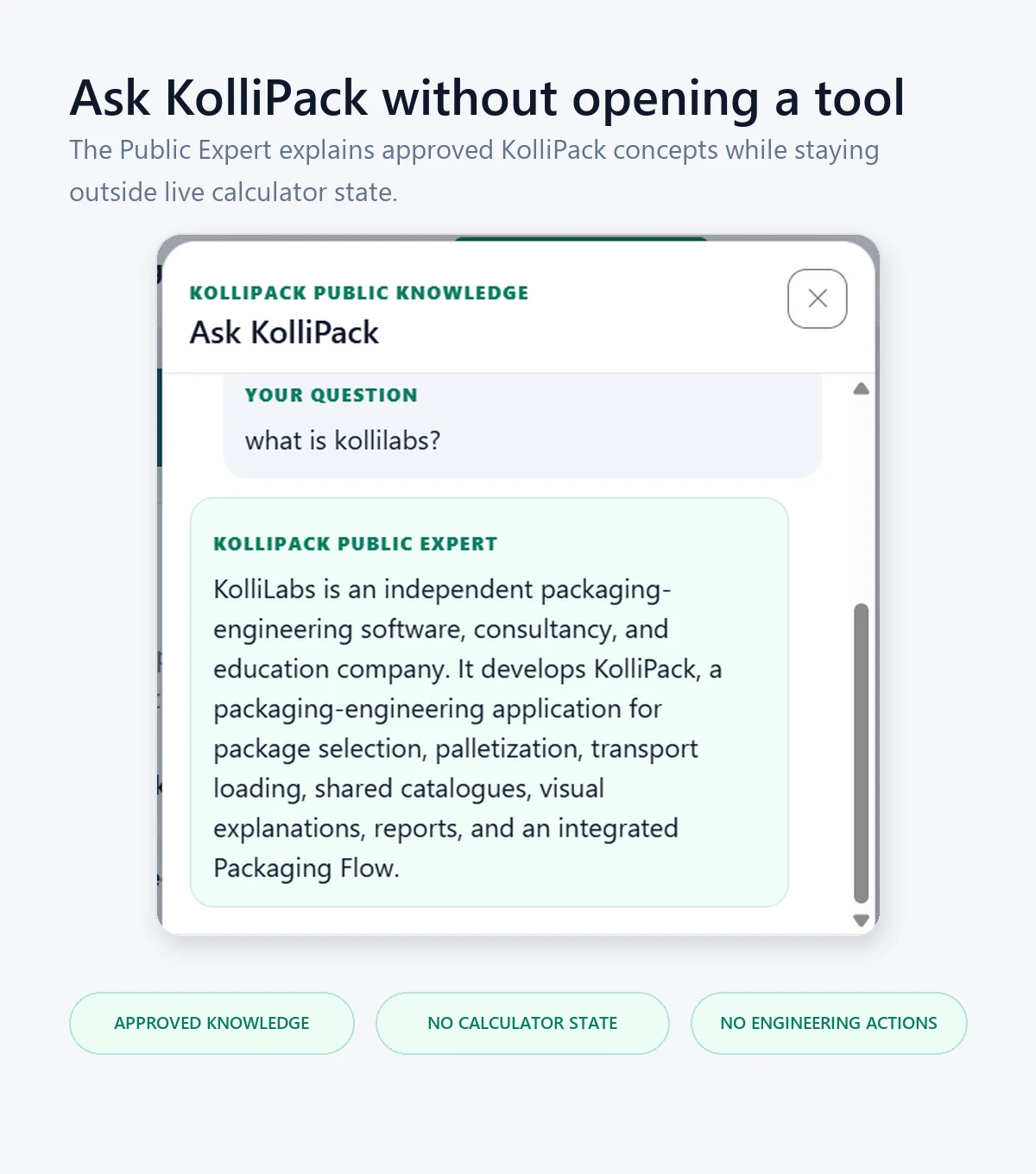
You can ask the Public Expert on the KolliLabs site. It is intentionally a knowledge experience, not a public route into private or live engineering state.
From a sentence to engineering inputs
The tool Assistant becomes valuable when the user is already working inside a supported KolliPack context. The production example starts with this request:
Could you please calculate max quantity of product 200 × 150 × 200 mm that fits in a 300 × 300 × 300 mm box?
The current Container Selection state is incomplete, so the Assistant does not invent a quantity or perform an informal calculation. It recognizes the dimensions in the request and asks whether it should prepare a review proposal.
After the user confirms, KolliPack presents six proposed changes:
- Product length: blank → 200 mm
- Product width: blank → 150 mm
- Product height: blank → 200 mm
- Container internal length: blank → 300 mm
- Container internal width: blank → 300 mm
- Container internal height: blank → 300 mm
The application validates the proposed values and shows the resulting readiness of the input state. It also states, prominently, that the changes have not been applied. The user remains in control of the transition from interpreted intent to actual tool inputs.
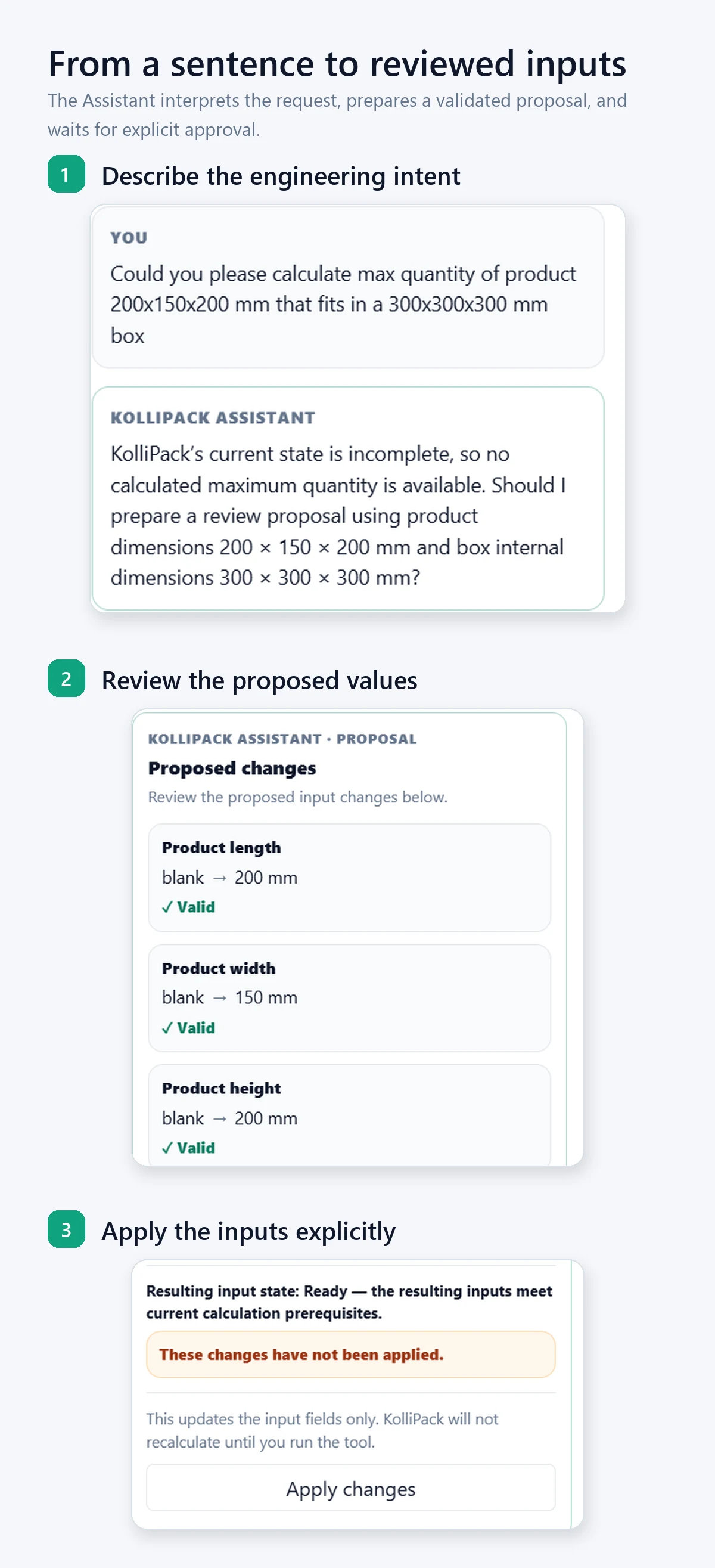
This review step matters because a sentence is not automatically an engineering instruction. Dimensions can be missing, ambiguous, unsupported, or inconsistent with the current source of a value. A structured proposal makes the interpretation visible before it affects the tool.
AI does not replace the calculation engine
Selecting Apply changes updates the input fields only. It does not recalculate the tool, select an engineering result, or turn the language model into the source of truth.
The user then runs Container Selection normally. For the supplied 200 × 150 × 200 mm product and 300 × 300 × 300 mm internal box, KolliPack calculates a maximum quantity of 2 pieces and 44% volumetric efficiency.
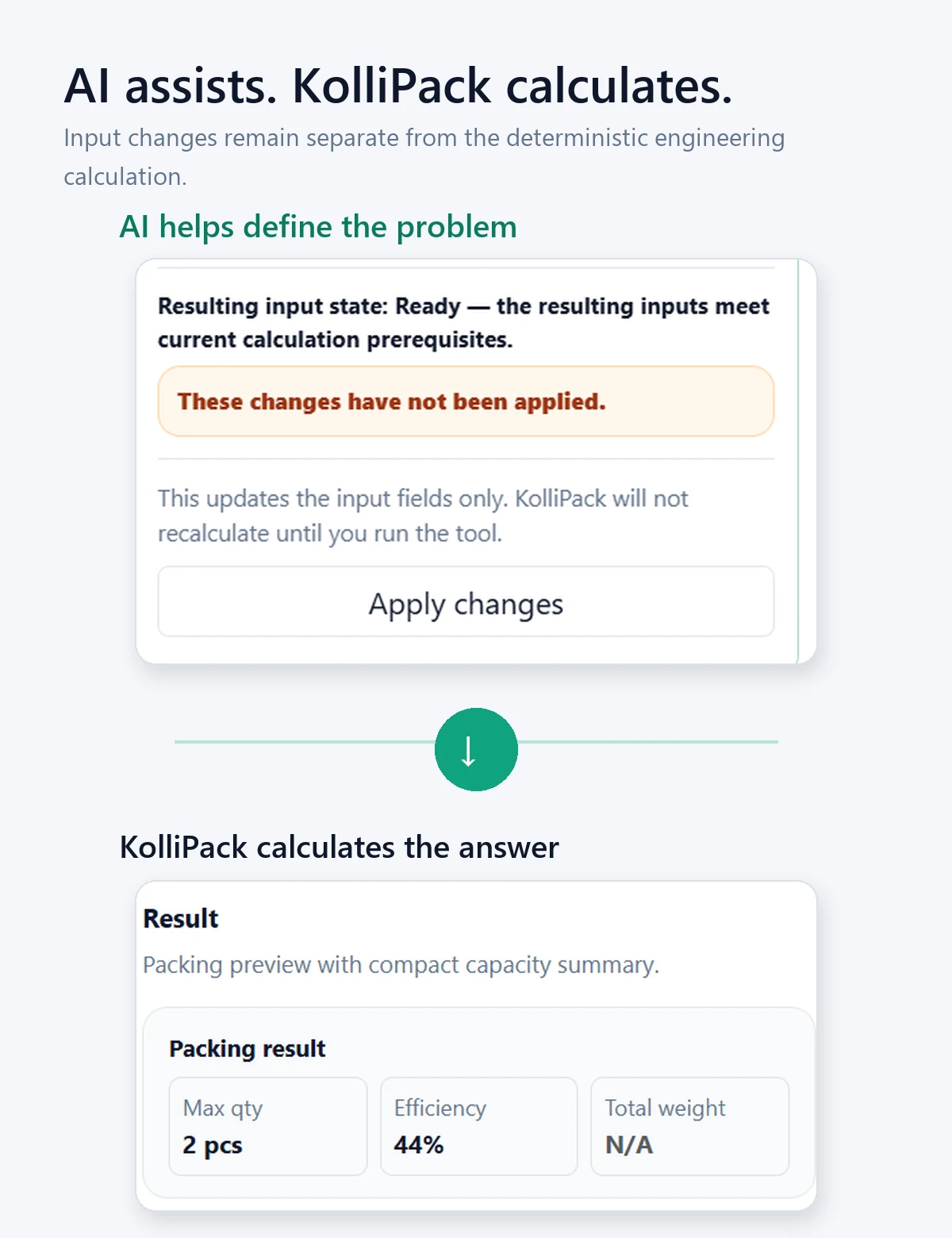
This separation preserves the part of engineering software that must remain auditable. Language is useful for interpreting intent and explaining context. Geometry, constraints, validation, and reported results remain the responsibility of KolliPack’s established calculation path.
Readers who want to explore the underlying packing problem can see why box selection is a 3D bin-packing problem or try the public KolliPack Box Size Calculator.
Why this matters beyond one calculator
The immediate benefit is practical: a user can ask what is missing, understand the current state, and express supported changes without first remembering every field name. The larger idea is a new interaction model for technical software.
Instead of forcing every task to begin with navigation, the software can increasingly meet the user at the level of intent:
- “Explain this restriction.”
- “What information is missing?”
- “Use these product and container dimensions.”
- “Prepare the change so I can review it.”
That does not remove forms. Precise controls remain essential for review, correction, repeatability, and calculation. Conversation becomes another way into the same engineering workflow—one that helps connect a person’s objective with the structured inputs the tool needs.
Today, the tool-aware Assistant is bounded to supported Container Selection contexts, including standalone Container Selection and Container steps inside Packaging Flow for eligible accounts. The Public Expert is available on supported public KolliLabs and calculator surfaces. Capability availability can depend on the user’s account or plan; current KolliPack pricing and access details are listed here.
For an example of why connected decisions matter, see how KolliPack Packaging Flow follows a box choice into palletization and transport.
A new interface for engineering decisions
Ask KolliPack is not important because it adds a chat panel. It is important because users can begin expressing engineering intent in natural language, turn that intent into reviewed tool inputs, and then rely on KolliPack for the calculation.
That is how conversational engineering software should earn trust: clear boundaries, visible proposals, explicit approval, and deterministic results.
Try Ask KolliPack on the KolliLabs site, or open Container Selection in KolliPack to explore the tool workflow. In either experience, the governing principle remains the same: KolliPack calculates. AI interprets, explains, and proposes.