
In a public TOPS MaxLoad example, the optimized 40-ft high-cube load contains 1,285 load units. KolliPack reproduced that exact manifest and loaded all 1,285. The more useful test came next: instead of treating visible unused space as proof, we added cargo. The tested KolliPack Progressive Fill solution accepted another 34 units of SKU302473, taking this same fixture to 1,319 load units.
That is about 2.6% more load units in this specific test. It is not a claim that KolliPack is universally better, that TOPS could not produce another arrangement, or that either result is mathematically optimal.
Comparison scope. This article examines one supplied public TOPS MaxLoad reference case and the stated KolliPack inputs. It is not a complete product evaluation, and the conclusion should not be generalized beyond this fixture. KolliLabs/KolliPack is independent of and not affiliated with TOPS Software Corporation.
Why an external reference case is useful
A benchmark designed around our own software can accidentally favor the way that software works. A public case created elsewhere is more demanding: the container, load-unit sizes, quantities, and reference result were not selected to make KolliPack look good.
This fixture also asks a practical question for a distribution or transport-planning team. If several rectangular case types must share one high-cube container, does the calculated arrangement merely look compact, or does it leave space that can accept additional load units? The distinction matters because nominal cargo volume and usable geometric space are not the same thing.
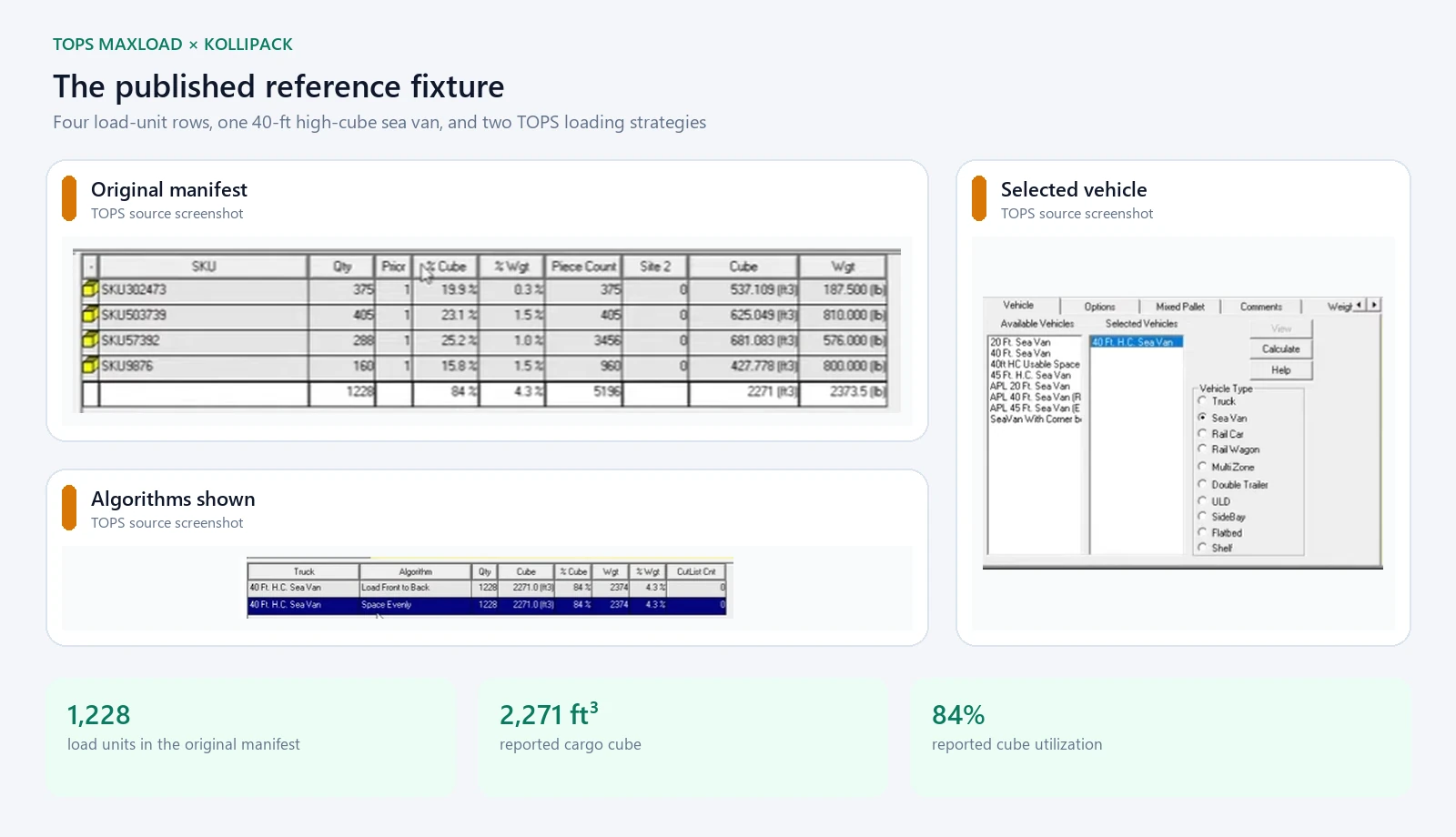
The TOPS source starts with four quantity-level load units. Its interface also displays a separate piece count for some rows, so this article consistently uses load units, not consumer pieces.
| ID | TOPS / KolliPack label | Dimensions (mm) | Original qty | TOPS optimized qty |
|---|---|---|---|---|
| P1 | SKU302473 | 457.2 × 279.4 × 317.5 | 375 | 400 |
| P2 | SKU503739 | 431.8 × 318.77 × 317.5 | 405 | 405 |
| P3 | SKU57392 / Case Pack 12 | 558.8 × 377.444 × 317.5 | 288 | 288 |
| P4 | SKU9876 / Case Pack | 558.8 × 355.6 × 381.0 | 160 | 160 |
| P5 | Case 1 | 558.8 × 406.4 × 317.5 | — | 32 |
Reconstructing the original 1,228-unit fixture
TOPS displays a 474 × 93 × 106 in internal loading space. Those rounded values correspond to approximately 12,039 × 2,362 × 2,692 mm, which is the metric fixture used for the KolliPack reconstruction. The original four rows total 1,228 load units and approximately 2,271 ft³ of product-envelope volume. The source reports about 84% cube utilization; the current KolliPack backend calculates 84.008% from the supplied metric dimensions.
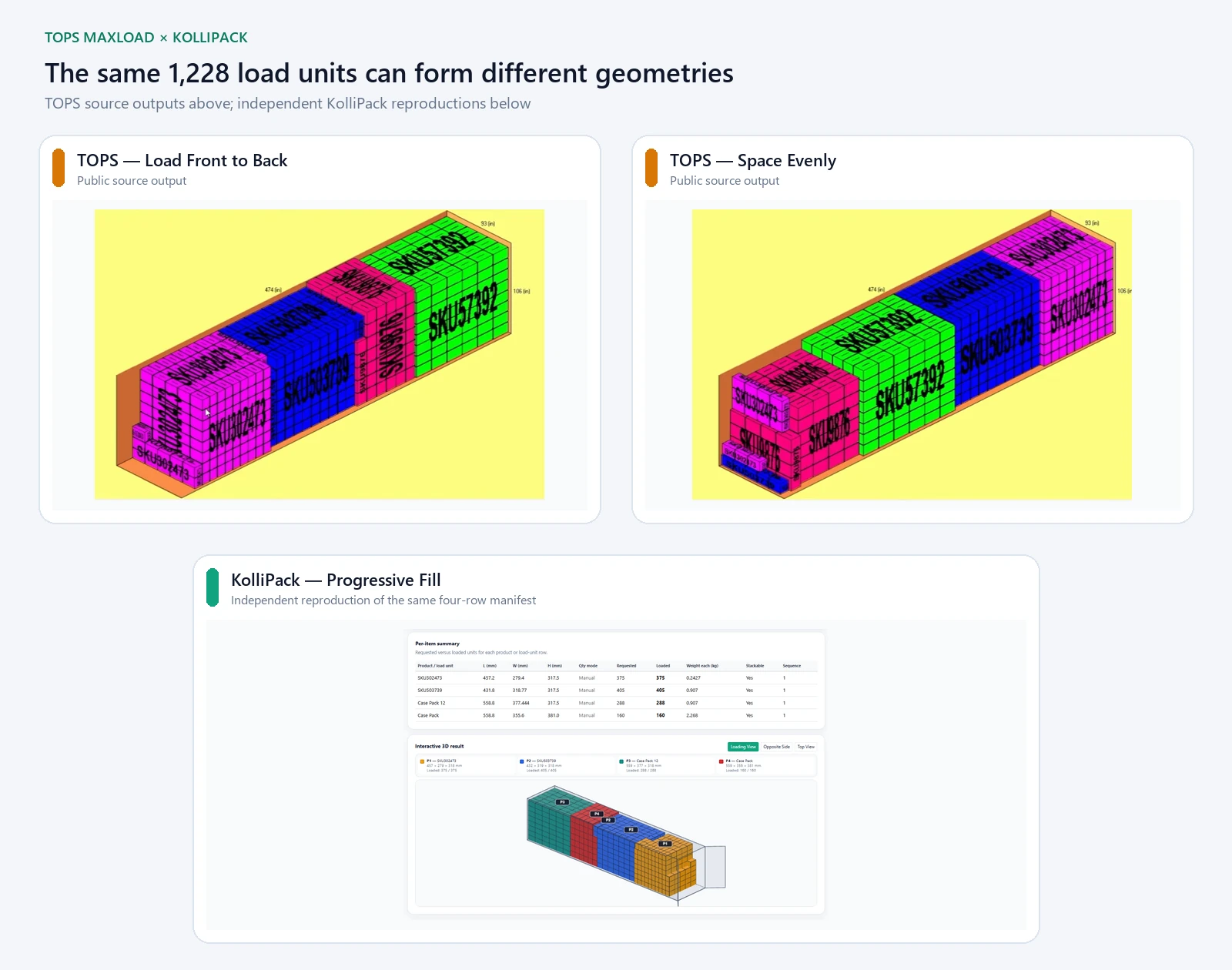
The source shows two TOPS outputs: Load Front to Back and Space Evenly. KolliPack's current strategies are Progressive Fill and Balanced Spread. Similar names or visual objectives do not make the algorithms equivalent; they are independent implementations.
The layouts make a central point visible. When the same cargo occupies the same container, the aggregate cargo-volume percentage is essentially fixed. What changes is the arrangement: where product blocks end, how the longitudinal footprint develops, and whether the remaining shapes can accept another load unit.
TOPS pushes its example from 1,228 to 1,285
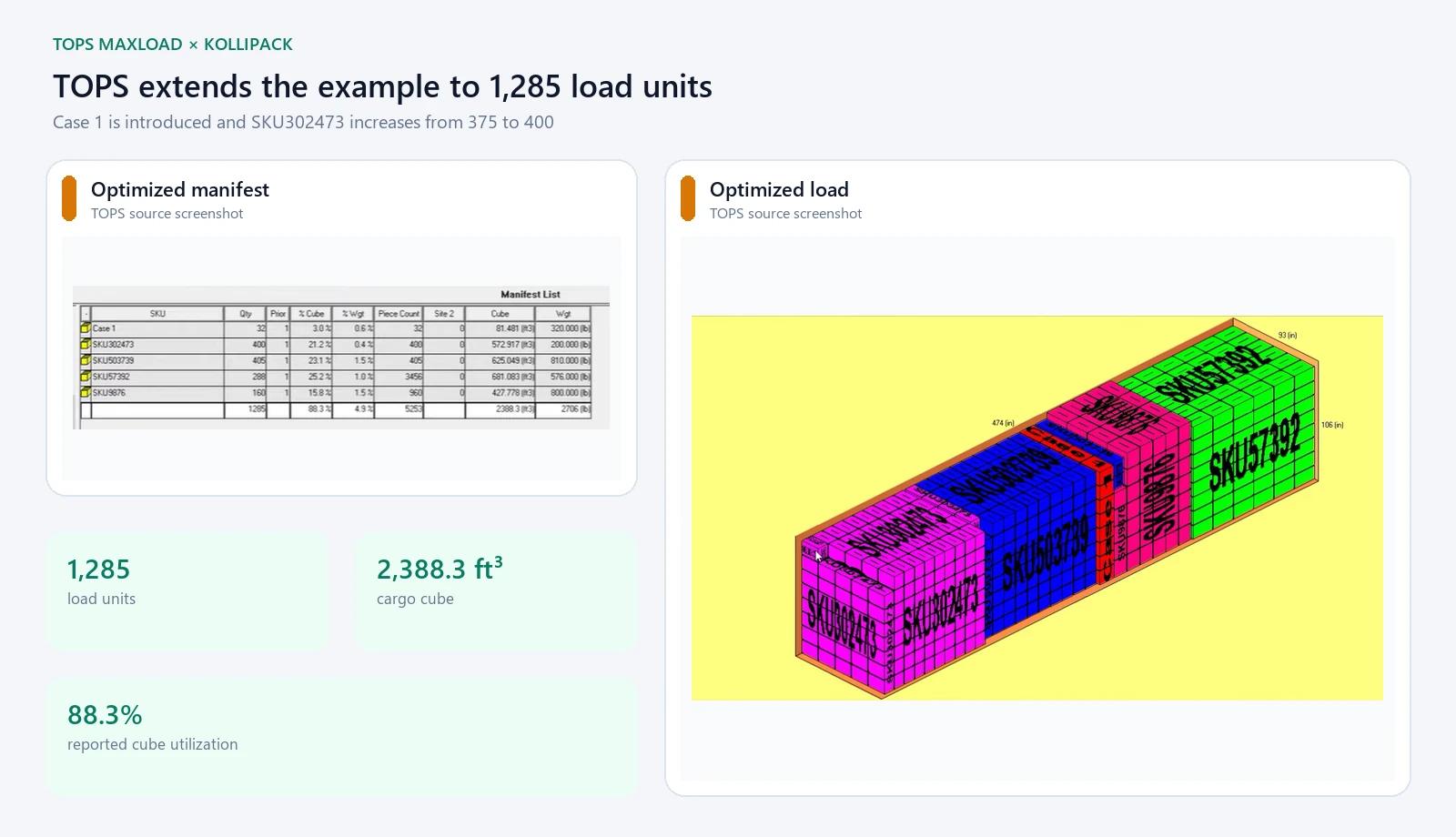
The published example does not stop at the original manifest. TOPS increases SKU302473 from 375 to 400 and introduces 32 units of Case 1. The other three quantities stay fixed, producing a five-row manifest of 1,285 load units.
The source reports approximately 2,388.3 ft³ of cargo cube and 88.3% cube utilization for this later result. The current KolliPack backend independently calculates 2,388.3 ft³ and 88.347% from the metric fixture. This is the important apples-to-apples control: the later TOPS manifest—not a different quantity mix—becomes the primary benchmark.
The exact TOPS manifest loads in KolliPack
KolliPack then received the same five requested quantities: 400, 405, 288, 160, and 32. Progressive Fill loaded every row completely, for 1,285 of 1,285 requested units. A secondary backend check also loaded the full manifest with Balanced Spread, although its calculated geometry differed.
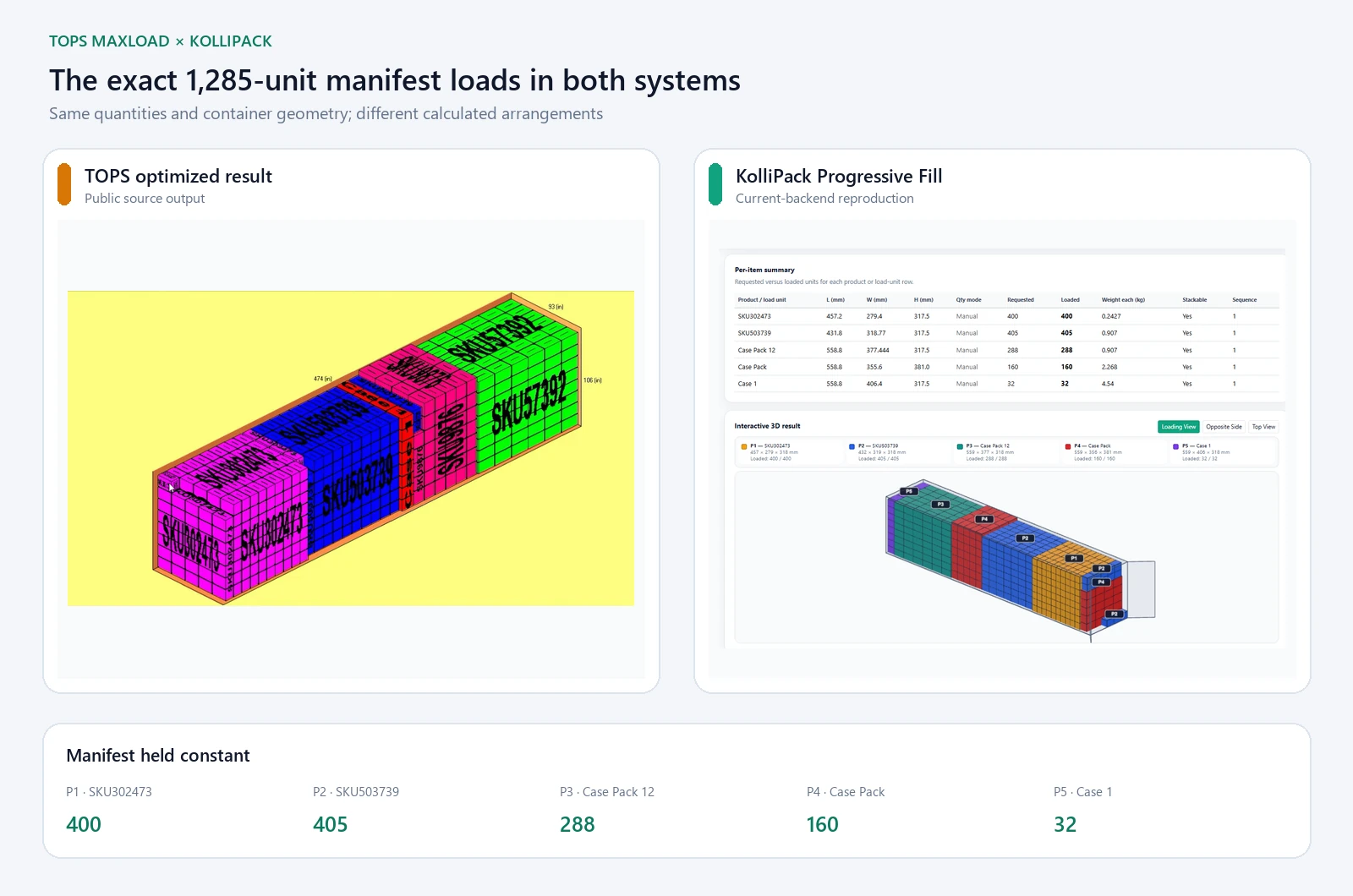
The visual difference suggests that the KolliPack arrangement may retain usable capacity. But an empty-looking region is not enough evidence. Container utilization measures how much nominal product-envelope volume is present; it does not prove that every remaining cubic metre has the right shape, support, and orientation for another case.
The stronger question is therefore direct: can another load unit actually be placed?
Two separate tests of the remaining geometry
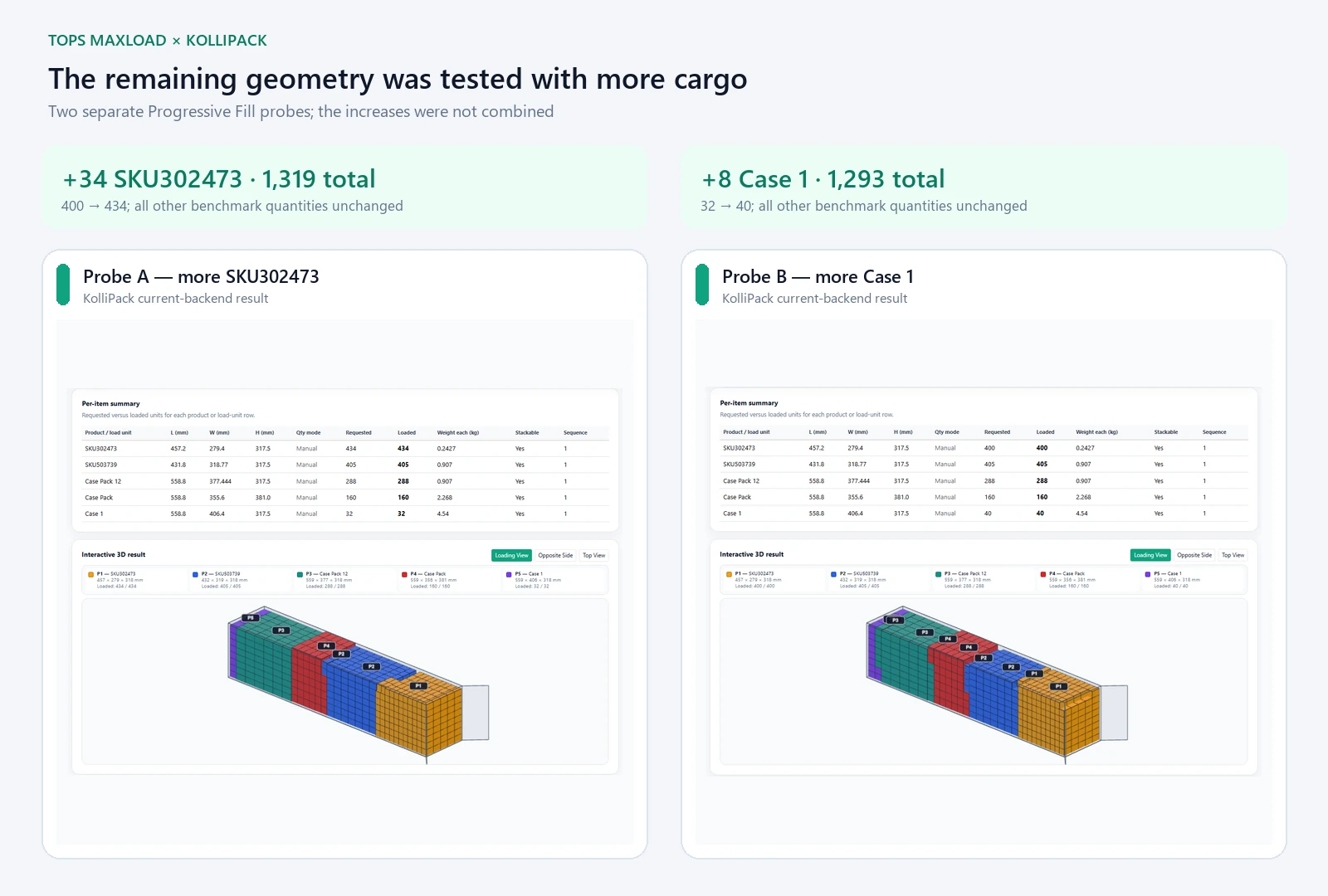
The first probe keeps the entire 1,285-unit TOPS manifest and increases only SKU302473 from 400 to 434. Progressive Fill loaded all requested units, reaching 1,319. The 34 added units contribute about 48.7 ft³ of product-envelope volume, bringing calculated cargo cube to approximately 2,437.0 ft³ and volume utilization to 90.148%.
The second probe asks a different question. It returns SKU302473 to 400, holds the other TOPS quantities constant, and increases only Case 1 from 32 to 40. KolliPack loaded all 40 Case 1 units, reaching 1,293 load units. Those eight added cases contribute about 20.4 ft³, for approximately 2,408.7 ft³ and 89.100% calculated volume utilization.
These are separate experiments. The extra 34 SKU302473 units and the extra eight Case 1 units were not loaded simultaneously.
| Test | P1 | P2 | P3 | P4 | P5 | Total |
|---|---|---|---|---|---|---|
| Original TOPS case | 375 | 405 | 288 | 160 | — | 1,228 |
| TOPS optimized result | 400 | 405 | 288 | 160 | 32 | 1,285 |
| KolliPack exact reproduction | 400 | 405 | 288 | 160 | 32 | 1,285 |
| Progressive Fill probe A | 434 | 405 | 288 | 160 | 32 | 1,319 |
| Progressive Fill probe B | 400 | 405 | 288 | 160 | 40 | 1,293 |
Why two probes are more informative than one
An unused region can be real yet highly product-specific. A narrow strip may accept one case orientation while rejecting another; a shallow top space may contribute nominal cubic volume without providing enough continuous support or height for the next unit. That is why a single cube percentage cannot describe the practical value of every empty region.
Probe A tests the strongest quantity result with SKU302473. It shows that the arrangement can absorb 34 more of that load unit without reducing any quantity from the optimized TOPS manifest. On its own, however, that result could be dismissed as a particularly convenient fit for the smaller P1 envelope.
Probe B provides a different challenge. Case 1 has a larger product-envelope volume than SKU302473, and the test changes only its quantity from 32 to 40. Loading all eight additional units does not prove that the remaining geometry is generally flexible, but it does show that the observed capacity was not limited to inserting more of only one smaller load-unit type.
Together, the probes make the evidence more useful while keeping it bounded: the same 1,285-unit reference manifest supports two independent quantity extensions, but the article does not combine them or extrapolate beyond the tested products and orientations.
For a planner, the business meaning is deliberately modest: under this dimensional fixture, the tested KolliPack arrangement carried more load units in the same container. No shipment volume, freight price, or annual operating data was supplied, so the benchmark does not convert that result into invented cost or sustainability savings.
What this benchmark demonstrates—and what it does not
The evidence supports a narrow conclusion: in this specific published fixture, the tested KolliPack Progressive Fill solution reproduced the complete 1,285-unit TOPS result and then accommodated additional cargo. The strongest probe reached 1,319 by adding 34 SKU302473 load units. The second probe independently showed that the residual geometry could also accept eight more of the larger-by-volume Case 1 load unit.
The result does not establish universal KolliPack superiority, mathematical global optimality, or the limit of what another TOPS configuration, version, setting, optimization pass, or operator might achieve. It does not compare price, calculation speed, interface design, feature coverage, or commercial value.
The calculated geometry is decision support. It does not certify physical load stability, compression performance, cargo restraint, transport safety, loading ergonomics, handling requirements, regulatory compliance, or a released logistics instruction. Those decisions require the actual load units, transport unit, operating method, and appropriate physical and safety review.
Readers interested in broader algorithm evidence can also review How Good Is KolliPack at Container Loading? An Honest Benchmark, which asks a different question across a large public benchmark suite.
Try the same high-cube fixture
The prepopulated high-cube benchmark opens the original four-row, 1,228-unit setup. From there, you can change quantities and loading strategy, add the Case 1 row, and observe how the calculated geometry changes.
The exact route is retained so the benchmark can be revisited against the current shared Transport Container engine rather than a separate article-only implementation.
Evidence and publication note
The TOPS panels are faithful compositions of screenshots supplied from MaxLoad - Container Loading Optimization, published by TOPS Software Corporation on 7 May 2020 and accessed for this benchmark on 20 October 2026. The video does not identify the MaxLoad software version, so no version is inferred. The KolliPack values were reproduced on the current repository backend snapshot dated 20 October 2026.
The article author supplied the public source URL and approved publication of this bounded comparison, including the supplied screenshot excerpts, on 20 October 2026. That approval is recorded as the publication and rights review for this article; it is not presented as an independent legal opinion or as endorsement by TOPS Software Corporation.